Purdue Global's DNP runs roughly 50 quarter credits with core coursework at a verified $700 per quarter credit, under the doctoral scale where the ladder is A, B, F and everything below 80 fails. The NU-prefix coursework is practice-change writing at doctoral register, evidence synthesized and appraised, organizational data argued into improvement, culminating in sustained project work. We draft it all in doctoral register in 24 to 48 hours per deliverable, with project stages run as dated plans.
The doctorate's shape
The DNP keeps the university's term structure while raising both altitude and stakes: doctoral rubrics expect appraisal rather than citation, synthesis rather than summary, and the grading scale removes the C entirely. At $700 per core credit, a repeated course is the most expensive event available at this university, which makes the doctoral scale's 80 floor a financial fact as much as an academic one. Consistency is not a virtue here; it is the business model.
The doctoral scale, respected properly
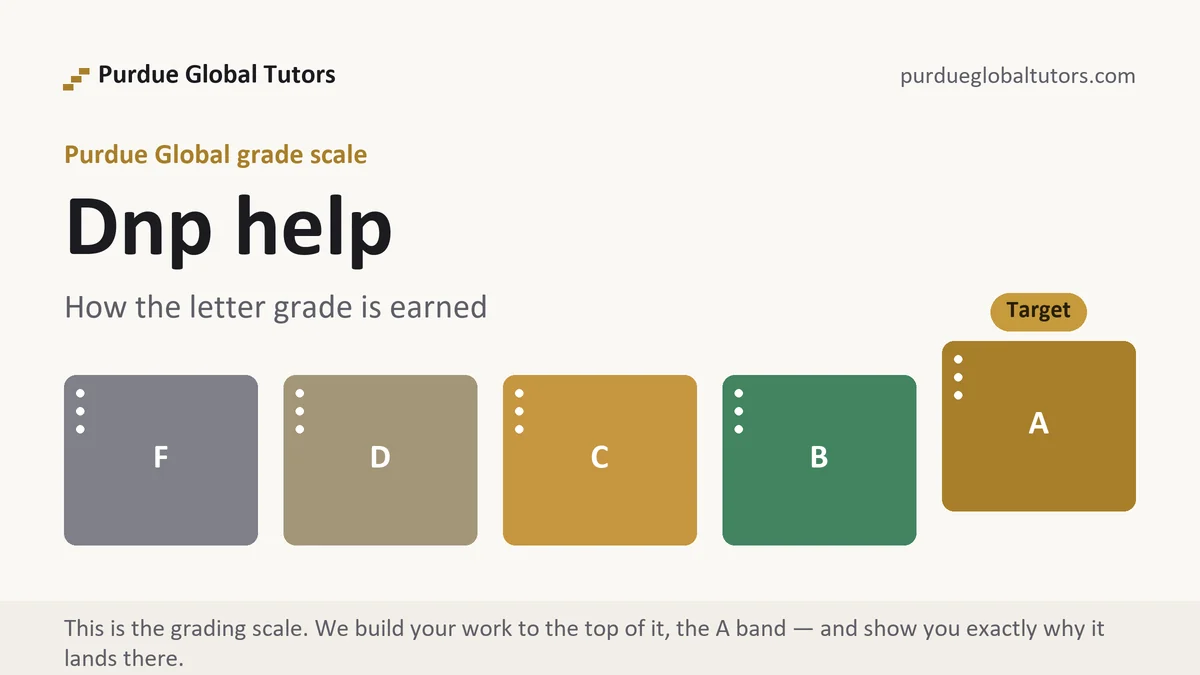
A, B, F: 90 and up is an A, 80 to 89.99 is a B and the last rung, 79.99 fails. The private target is therefore 90 on every deliverable, margin built in, because aiming at the floor of a two-rung ladder is how doctorates stall. Every DNP draft we deliver is scale-checked against that line before it reaches you, and the running gradebook math is part of the term map, not an afterthought.
The project work, run like the long game
Doctoral nursing projects move through gated stages, problem, evidence, methods, implementation, evaluation, each dependent on approvals, each written at a register that must survive committee reading. We stage the work with real dates, draft through the two-QA pipeline in doctoral voice, prepare the supporting paperwork, and keep the next stage drafted before the current one clears review. Clinical and practicum threads run beside the writing without stalling it; that parallel motion is the entire difference between two years and four.
The nine-course spine, NU 702 to NU 806
The 2026-2027 catalog builds this doctorate as nine courses and 50 quarter credits, every code visible in advance, which makes the DNP the most mappable degree at the university. Seven of the nine publish supervised practice hour ranges directly in their course descriptions; two carry none. The spine, in catalog order:
- NU 702 Translating Evidence into Nursing Practice (6 quarter credits): opens the program; published range of 30 to 60 supervised practice hours.
- NU 704 Biostatistics, Epidemiology, and Social Determinants of Population Health (5 quarter credits): no hour range printed; the writing carries the full grade.
- NU 706 Ethics, Policy, and Advocacy in Population Health (5 quarter credits): the second course with no printed range; policy argument at doctoral register.
- NU 708 Advanced Systems Leadership: Transforming the Health Care Organization (5 quarter credits): 50 to 100 hours.
- NU 710 Advanced Health Information and Technologies (5 quarter credits): 50 to 100 hours.
- NU 712 Quality Improvement and Interprofessional Collaboration for the Doctoral Nurse (6 quarter credits): 60 to 120 hours.
- NU 802 DNP Project I (6 quarter credits): 100 to 200 hours; the gate every later course depends on.
- NU 804 DNP Project II (6 quarter credits): 125 to 250 hours, the widest range in the program.
- NU 806 DNP Project III (6 quarter credits): 85 to 170 hours; the program closes where committees read hardest.
Students who started before the 2026-2027 catalog are finishing the earlier nine-course spine, which stays in the catalog: NU 703, NU 713, NU 733, NU 743, NU 753, NU 800, NU 803, NU 813 and NU 823, also 50 credits with the same hour totals.
Nine courses at ten weeks each is 90 instructional weeks taken one at a time, which is the honest calendar shape of this doctorate before breaks and scheduling are layered in. And since the site's verified core rate is $700 per quarter credit, 50 credits price out at $35,000 if every credit bills at that rate, which turns the doctoral scale's no-C ladder into a budgeting instrument: on this spine, a repeated six-credit course is a $4,200 event.
One thousand hours, worked as arithmetic
The requirement is verified and exact: one thousand postbaccalaureate practice hours are required for DNP degree completion, and up to 500 prior postbaccalaureate hours can be accepted toward them. Now add up the published per-course figures. The minimums, 30 plus 50 plus 50 plus 60 plus 100 plus 125 plus 85, total exactly 500. The maximums, 60 plus 100 plus 100 plus 120 plus 200 plus 250 plus 170, total exactly 1,000. That symmetry is the entire planning story of this degree, and almost nobody applying to it has done the addition.
Read the three cases off those two sums. A student whose full 500 prior hours are accepted can ride the published minimums through all seven hour-bearing courses and land on 1,000 precisely. A student entering with zero accepted prior hours must run every course at or near its published maximum, because the maximums sum to 1,000 with no slack anywhere in the spine. And the middle case scales linearly: enter with 200 accepted hours and you owe 800 in-course, which is 300 above the minimum path, an average of a bit over 40 extra hours in each of the seven courses. For students whose state boards mandate hours beyond even that, the catalog provides NU 820A Graduate Extension Course at zero credits. Whatever your entry math, compute it before term one, because the difference between the minimum path and the maximum path is 500 hours of your working life.
One more division worth doing before you enroll: spread each range across the ten weeks of its course. NU 804's 125 to 250 hours means 12.5 to 25 practice hours every single week of that term, on top of the written project work the course grades. NU 802's 100 to 200 means 10 to 20 weekly hours in the same term you are drafting the project plan that the rest of the doctorate depends on. Even NU 702's gentle 30 to 60 is a standing three-to-six-hour weekly appointment from the first course onward. Students who see those weekly numbers early arrange their work schedules around the heavy terms; students who discover them mid-course are the ones asking for extensions. The per-week division takes five minutes and reorganizes two years.
Ten weeks at doctoral register, week by week
The doctorate keeps the university's weekly machinery: deliverables on fixed days and live seminars inside Brightspace, term after ten-week term. What changes is what a week costs to produce. A doctoral deliverable is expected to appraise evidence rather than report it, argue from organizational data rather than describe it, and hold a register that would survive a committee member reading it cold, and it is graded on the ladder where 80 to 89.99 is a B and 79.99 fails. On a two-rung scale the distance between comfortable and gone is ten points, which is why our working target on every DNP draft is the 90 line, not the floor. Six-credit courses compound the load: more output per week than the five-credit population courses, in exactly the terms that also carry the heaviest practice-hour ranges. The practical system is unglamorous: each week's deliverable drafted early against the rubric, returned to you in 24 to 48 hours with room for your revision pass, seminar weeks flagged in advance, and the running gradebook computed on the doctoral scale so you always know your actual distance from 80. Doctorates are not lost in dramatic single failures; they are lost a slightly-late, slightly-thin week at a time, and the whole service is built against that erosion.
The project arc and the two clean courses
NU 704 and NU 706 are the spine's two clean courses, the population health pair with no printed hour range, and they deserve respect precisely because writing is all they grade: epidemiology argued from data in one, ethics and policy advocacy sustained at length in the other, both on the scale where 79.99 fails. The three-course project arc that follows is the doctorate's center of gravity: NU 802, NU 804 and NU 806, DNP Project I through III, carry the project from proposal through implementation to dissemination for readers who judge like reviewers. On the earlier spine the same arc runs NU 800, NU 803, NU 813 and NU 823. Each stage has its own register, and each stage's document inherits every weakness of the one before it, which is why we keep the next stage drafted before the current one clears. Bring us the spine at NU 703 or join at NU 813 mid-project; the support meets the stage where it stands.
What the catalog does not print
Honesty about the edges of this arithmetic. The one thousand hours are the university's completion requirement; what a given state board expects for its own purposes is a separate question that varies by state, which is exactly why NU 820A exists as a zero-credit extension vehicle. How many of your prior postbaccalaureate hours actually get accepted, up to the 500 ceiling, is an individual determination made at entry, not a number anyone can promise you in advance, so get that acceptance in writing before you build your plan on it. And the two population health courses, NU 713 and NU 733, print no hour range in their descriptions; we read that as writing-weighted courses, but the authoritative word on any hour question is your program, not a tutoring site. Where the catalog is exact we are exact, and where it is silent we say so. That division of confidence is deliberate, and it is the same standard we hold in the drafts themselves.
Whose hours the thousand are
A boundary, stated plainly because this page just spent two sections on hour arithmetic: the arithmetic is ours, the hours are yours. We never perform or complete practice hours, never locate or approach preceptors or practice sites, never sign placement or affiliation paperwork, and never enter anything into an hour log. What we build is everything written around the thousand: the course deliverables, the proposal, the analysis chapters, the implementation reporting, the dissemination manuscript, delivered on the 24 to 48 hour rhythm so your practice weeks and your writing weeks stop fighting for the same nights.
The three DNP questions we answer most
How many practice hours does the Purdue Global DNP require?
Can the published course ranges alone reach 1,000 hours?
Do you complete practice hours or handle preceptor paperwork?
Bring the course, or bring the project
A single DN-level week or the full project plan. Doctoral-register drafts, first premium sample free.