Purdue Global closed the RN to BSN ExcelTrack option to new enrollments and reentries as of October 15, 2025, so new students now complete the degree on the traditional weekly bundle at $315 per quarter credit on the nursing scale, where below 75 fails. The RN license itself still grants a large credit block before you pay for anything. We draft weekly work to an A in 24 to 48 hours with the 75 floor guarded, and we still support continuing students inside an ExcelTrack term, clearing each summative at 80 first-attempt.
The pathway choice, decided honestly
Since October 15, 2025 the ExcelTrack version is closed to new enrollments and reentries, so a nurse starting the RN to BSN today enters on the traditional path: fixed weekly deadlines, the assignment-board-seminar bundle, cumulative grading that pays for consistency. Nurses already inside an ExcelTrack term keep its levers, self-directed modules, summative-only grading, flat terms that reward density, and readiness checks that let years of practice test past familiar material. Either way the wrong pacing costs real money, so bring your honest week to the chat and we will map it before you commit.
The 75 floor, the rule that changes triage
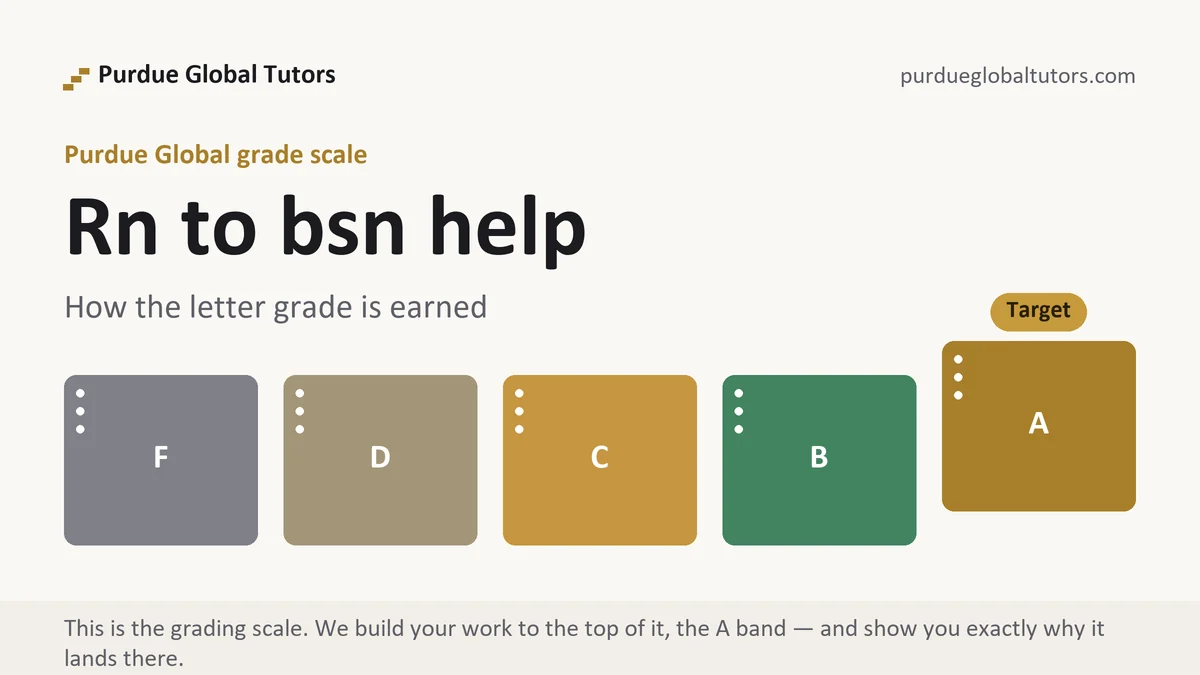
The School of Nursing's undergraduate scale has no low passes: C runs only 75 to 76.99 and below 75 is an F. That converts "just get through this course" from a strategy into a hazard, because a 72 that would pass a standard undergraduate course fails a nursing one. Every nursing draft we deliver is floor-checked against this scale specifically, and the term map treats nursing weeks as fixed points while gen-ed weeks flex around them.
The license credit, claimed before it matters
The RN license grants a substantial block of credit toward the BSN before tuition applies, and transfer plus prior-learning routes, assessment credit through ASK, experiential credit for documented practice, can shrink the paid catalog further. Get the full evaluation before you enroll, because the size of the remaining catalog is exactly what your per-credit tuition tracks.
The service, tuned per pathway
On the traditional path: the ten-week map across all courses, boards and assignments drafted ahead of their deadlines, seminar weeks prepped, everything scale-checked at the 75 line with margin. For continuing ExcelTrack students: the module map, readiness-check calls made honestly, written summatives drafted against the competency lists, exam-style summatives drilled, no module ever idling inside a flat term. Same team, both rulebooks, first premium sample free on whichever week is in front of you.
The nursing grid, line by line
The RN to BSN curriculum grid runs nine lines, and knowing them by code turns a vague degree into a checklist. The catalog builds the whole degree at 180 quarter credits with 119 of them satisfied through licensure and prior learning, which means the nursing grid below, 46 quarter credits of it, is the heart of what you will actually sit through week by week. The remaining balance outside the grid depends on your individual transfer evaluation, which is one more reason to get that evaluation before enrolling rather than after. Here is the sequence as the catalog prints it:
- NU 300 Professional Leadership Transitions (6 quarter credits): the entry course, where practicing RNs reframe bedside experience as baccalaureate-level leadership writing.
- NU 325 Evidence-Based Nursing (5 quarter credits): the evidence course the rest of the grid leans on; the appraisal habits formed here get reused in every later paper.
- NU 333 Health Assessment for the Nursing Professional (5 quarter credits): assessment writing at documentation grade, where charting instincts meet academic rubrics.
- NU 425 Transforming Leadership and Management in Nursing (5 quarter credits): management cases and change writing, argued rather than described.
- NU 465 Public Health Nursing - Evidence for Practice (5 quarter credits), or NU 505 Clinical Epidemiology and Population Health Promotion (5 quarter credits): the population slot. NU 505 also sits in the MSN core, so a nurse already planning a master's can meet graduate coursework early by taking the swap.
- NU 470 Regenerative and Restorative Care Spheres - A Wellness and Prevention Focus (6 quarter credits): the first of the two six-credit spheres courses.
- NU 475 Providing Transition Care - Chronic Disease and Palliative/Hospice Spheres (6 quarter credits): the second spheres course, chronic disease and palliative care written with precision.
- NU 480 Four Spheres BSN Capstone (4 quarter credits): the written synthesis of the entire grid.
- NU 480CL Four Spheres BSN Capstone Practicum (4 quarter credits): the practicum companion, covered honestly in its own section below.
The same grid, worked as a term plan
Purdue Global runs ten-week terms on the quarter-credit system, so the grid converts directly into calendar. Pair the courses and the arithmetic is short: NU 300 with NU 325 makes an eleven-credit opening term, NU 333 with NU 425 a ten-credit second, the population slot with NU 470 an eleven-credit third, NU 475 stands alone as a lighter fourth, and NU 480 with NU 480CL close the degree together, a five-term plan of roughly fifty instructional weeks. Take one course per term instead and the same grid stretches to eight terms, since the capstone pair still rides together, roughly eighty instructional weeks. Registration order and load are set with your advisor and your evaluation, so treat both versions as planning arithmetic rather than a promise. The useful part is the gap: the difference between the two honest paces is about thirty weeks, and the deciding variable is not ambition but what your shift schedule can absorb for ten weeks at a stretch.
Sequence logic matters as much as pace. NU 300 opens because everything after it assumes its professional-role framing, and NU 325 belongs early because the spheres courses and the capstone keep asking for evidence handled the way NU 325 teaches it. Load the two six-credit courses, NU 470 and NU 475, into terms where work is calmest, because six credits carry proportionally heavier weekly output than five, and hold NU 480 for last on purpose: a capstone written beside three unfinished courses reads exactly like what it is.
The money arithmetic rides on the same numbers. At the nursing rate of $315 per quarter credit, the 46-credit grid prices out around $14,490 before any scholarship, employer benefit, or additional transfer credit is applied, and each credit the evaluation removes is $315 you never spend. That is why the evaluation belongs before enrollment: the grid is fixed, but the total around it is not.
What each ten-week course actually asks of you
Every course on the grid runs the same weekly rhythm inside Brightspace: written deliverables due on fixed days plus live seminars, graded cumulatively across the ten weeks. On the nursing scale that rhythm has teeth, because the C band runs only 75 to 76.99 and below 75 is an F. Work the arithmetic once and the strategy writes itself: when a grade is assembled week by week, a pair of weak submissions in weeks one and two caps your ceiling before the term is a third done, and every remaining week becomes recovery math against a floor that sits fifteen points above the standard undergraduate one. The defense is front-loading: the opening weeks of each nursing course get drafted first, checked hardest, and banked, so the back half of the term spends margin instead of hunting for it.
The drafting itself shifts register as the grid climbs. NU 300 rewards clear professional reflection; NU 333 wants assessment written the way a chart reads, but cited; NU 425 and the spheres pair want change arguments built on evidence; the capstone wants all of it at once, sustained across a longer document. Our writers hold that progression in view, so a nurse who starts with us in NU 300 is not re-explaining voice, format, and source standards by the time NU 480 arrives.
NU 480 and NU 480CL, where the writing ends and the hours begin
The capstone pair splits the final term into two different kinds of work. NU 480 is written synthesis, four quarter credits of it, and it sits fully inside our scope: planning, drafting, and revision support at the same 24 to 48 hour rhythm as the rest of the grid. NU 480CL is different in kind. Its course description sets a minimum of 40 hours in the practicum setting, and those hours belong entirely to you. We do not complete practicum hours, we do not find or contact preceptors or sites, we do not sign placement paperwork, and we do not fill hour logs, not as fine print but as a hard boundary we state before you pay. What we do instead is keep the NU 480 writing load moving on schedule, so the weeks that contain your 40 practicum hours are not also the weeks you are drafting a capstone from scratch. Nurses who plan that final term with both halves visible finish it once; nurses who let the two collide are the ones who write us mid-term.
Reading your gradebook against the 75 line
Here is the mid-term arithmetic most nurses never run until it is too late. Suppose you are five weeks into NU 325 holding an 81 average, and suppose the remaining weeks carry roughly equal weight, actual rubric weights vary by course, so treat this as a model rather than your syllabus. One bad week at 60 pulls the running average to 77.5, still passing but with the entire C band as your only cushion. A second week at 60 lands the average at 75.0, which is the floor itself to the decimal. In other words, a student who feels safe at 81 midway through a nursing course is exactly two rough shifts-plus-deadlines collisions away from the line, and that is the calculation behind our standing advice: send the gradebook, not the vibe. We compute the actual standing on the actual scale, identify which remaining deliverables can move the number most, and draft those first. Margin in a nursing course is built deliberately or not at all.
Three questions RN to BSN nurses ask first
Which courses make up the Purdue Global RN to BSN nursing grid?
How many practicum hours does NU 480CL require?
How fast can the nursing grid be finished on ten-week terms?
Start with what is due
Tell us your pathway and your current course. First premium sample free, back in 24 to 48 hours.