NU 813 (catalog code NU813), DNP Project Implementation, is the term where your project runs live and the writing turns into reporting. Older cohorts and transcripts print this course as DN 813, DNP Project Implementation and Evaluation, the legacy numbering's implementation course. The graded documents are status and fidelity reports: what the approved plan said, what actually happened this period, what the data collection shows so far, and what you adjusted, with every deviation documented rather than smoothed over. The catalog attaches the widest practice-hour range in the program to this course, 125 to 250 supervised hours, and all of it is yours: the on-site work, the preceptor relationship, the logs. The reporting that wraps around it is where we work. This page maps how implementation reporting is graded, a worked budget for the period report, its anatomy, and the questions this course generates.
What NU 813 actually grades
Implementation writing is graded on fidelity, traceability, and judgment. Fidelity means the reader can lay your report next to the approved proposal and see the same intervention, the same measures, and the same setting, or an explicit amendment where they differ; the fastest way to lose points in this course is to drift from the plan silently, because a grader who catches one undocumented change stops trusting the rest of the document. Traceability means claims are anchored to records: dates, counts, session numbers, and collection points, so that saying week four's education sessions reached 19 of 24 scheduled staff is reporting, while saying most staff were reached is hoping. Judgment is what separates the grades, and it shows up in how you handle the inevitable problems. A unit gets busy, a champion rotates off, a data field stops being filled in; the doctoral move is to name the barrier, quantify its effect on the plan, choose an adjustment inside your approved scope, and document who agreed to it. Faculty grading this course have supervised enough projects to know that nothing runs clean, so a spotless report reads as unobservant rather than successful.
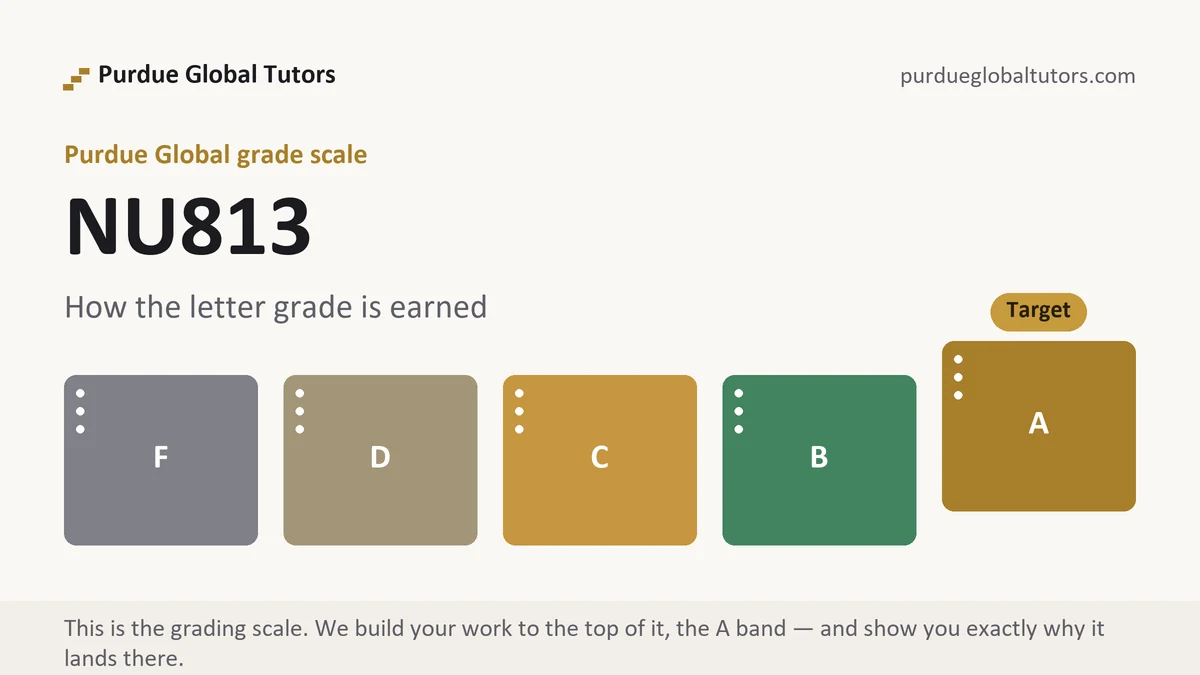
The container is the standard one: a ten-week term on quarter credits, deliverables most weeks, seminars live in Brightspace with a written alternative, and the doctoral scale overhead, A, B, or F, with everything under 80 failing. The pressure peculiar to NU 813 is that the writing deadlines and the site work compete for the same hours of your week, which is why the reporting needs to be systematic instead of heroic.
How we help in this course
Send the rubric, the report template, your approved proposal, and your raw notes for the period, bullet points, numbers, even a voice-memo transcript of what happened on site. The report comes back inside 24 to 48 hours with the period's events organized against the plan, the interim data stated with its denominators, the deviations framed and justified, and the register held at doctoral level throughout. Because these reports repeat, we keep your project's terminology stable across the term, so week eight uses the same measure names and section logic week two established.
The boundary needs its plainest statement on this page, because NU 813 is the most hours-heavy course in the doctorate. The catalog's 125 to 250 supervised practice hours are performed by you, at your site, under your preceptor or mentor, and logged and verified by you and them; we take no part in any of it, ever, for any deadline. We also do not manufacture implementation events: the report describes what you tell us happened, and if a week produced nothing, the report says so and accounts for it. Around that line, the full pipeline runs on every order: rubric decoded row by row, a writer matched to project reporting, a rubric QA pass, a separate APA and originality pass, and the scale check against the 80 floor.
In NU 813 right now?
Send the week and the rubric from Brightspace. First premium sample free, scale-checked, back in 24 to 48 hours.
Where NU 813 sits, and the older code
NU 813 is course eight of nine, fed directly by the proposal NU 800 approved and the baseline NU 803 fixed, and feeding directly into NU 823, where everything you record here becomes the results chapter. That position gives the course its discipline: any measure you rename, any window you shift, any group you redefine during implementation creates a reconciliation problem the dissemination term has to pay for. Continuing students on the legacy doctoral track may know this territory as DN 813, DNP Project Implementation and Evaluation, a DN-prefix catalog course whose title and rubric wording differ from the NU version, so verify the prefix on your registration before sending work. The doctorate has no ExcelTrack variant; the ten-week term is the only rhythm, and the unit is the only subdivision.
Turn the rubric into a word budget before you write
Status reports invite narrative sprawl: the week had drama, and drama is easy to write. The rubric does not pay for drama. Copy its rows in order and price them in words before you draft the period.
Worked example on an illustrative rubric (your section's own cap and rows set the real numbers): a period report capped at 2,200 words with five rows, plan recap and status against timeline at 15 percent, intervention fidelity at 25, data collection progress at 25, barriers and adjustments at 20, protections and next-period plan at 15. That buys 330, 550, 550, 440, and 330 words. Notice the shape the budget imposes: fidelity and data are the twin centers of the report, each owed more than the barrier story most drafts lead with, and the recap that students love to expand is the cheapest row on the sheet. If your section grades in points, run the division: a 100-point rubric across 2,200 words prices a point at 22 words, which makes a 25-point fidelity row a 550-word obligation that a two-sentence assurance cannot meet. Write the numbers into your template as headings with budgets attached, and the report drafts itself in order instead of by mood.
The parts of an implementation report
Section templates differ, but implementation reporting covers this ground everywhere, and each part has a version that costs points.
| Part | What it has to establish | The version that loses points |
|---|---|---|
| Status against timeline | Where the project stands versus the approved schedule, stated in dates and milestones | On track asserted without a milestone table anyone could check |
| Intervention fidelity | What was delivered, to whom, how many times, and how delivery matched the protocol | The intervention is going well, with no counts and no protocol reference |
| Data collection progress | Which measures were collected this period, completeness rates, and any instrument problems | Interim results editorialized into success before the collection window closes |
| Barriers and adjustments | Each obstacle named, its effect quantified, the adjustment chosen, and who approved it | A silent protocol change a committee discovers by comparing reports |
| Participant protections | Confirmation that consent, privacy, and data handling ran as approved, with any events disclosed | A boilerplate ethics sentence copied unchanged from the proposal |
| Next-period plan | Specific actions, owners, and dates for the coming weeks, revised for what this period taught | A restated original timeline that ignores the delays this very report described |
Evidence craft when the evidence is your own project
NU 813 inverts the citation problem: the primary source you cite most is now your own approved proposal, and the discipline is internal consistency. Quote your protocol exactly when you claim fidelity to it, cite your own measure definitions by name when reporting collection, and when you adjust anything, write the amendment as a formal object with a date and an approver, because future documents will need to cite it. External literature still appears, but with a narrow job: it justifies adjustments and interprets obstacles, as when staffing turbulence disrupts your delivery schedule and an implementation science source supports the modified approach you chose. Interim numbers demand particular care. Report them with denominators and completeness rates, resist trend language on partial windows, and label everything interim so no sentence reads as a finding before the evaluation is done; the phrase collection is 60 percent complete against plan does more doctoral work than any premature percentage improvement. Keep a running reconciliation habit: every number that appears in a period report should be recoverable from your collection records, because NU 823 will republish these figures and any mismatch between the implementation reports and the final paper is the kind of discrepancy committees hunt for sport.
Passing report, strong report
A passing NU 813 report accounts for the period, touches every rubric row, and contains no contradictions. A strong one demonstrates control. It opens with status a reader can verify in ten seconds, milestone by milestone. Its fidelity section counts things: sessions delivered against sessions planned, staff reached against staff targeted, protocol steps executed as written. Its barrier section reads like an engineer's log rather than an apology, each problem paired with a bounded, approved response. It handles protections as a living confirmation rather than a pasted paragraph. And it closes by revising the future honestly, adjusting the next period's plan to the velocity this period actually achieved. Across the term, the strong reports also agree with each other, same measure names, same denominators, same milestone labels, so the sequence reads as one project documented by one steady hand, which is precisely the impression a doctoral candidate wants standing behind them at the final defense.
Six mistakes that cost points here
- The silent pivot. Changing delivery method, sample, or measures without a documented amendment converts a manageable delay into an integrity question.
- Fidelity by vibes. Going well is not a fidelity claim; delivered 11 of 12 planned sessions per protocol is, and only one of them scores.
- Premature findings. Declaring improvement from a half-collected dataset forces NU 823 to either repeat the error or contradict you; both are expensive.
- The barrier dump. Listing obstacles without quantified impact or chosen response reads as venting, and the rubric row pays for management, not testimony.
- Recycled ethics language. Protections sections copied verbatim from the proposal signal that no one checked whether protections actually held this period.
- Timeline denial. A next-period plan identical to the original schedule, printed under a report full of delays, tells the grader the writer is not steering.
Questions NU 813 students ask
This course carries 125 to 250 practice hours. What exactly is left for you to do?
My implementation is behind schedule mid-term. How should the reports handle it?
Can you keep my weekly reports consistent with my approved proposal and each other?
Where NU 813 sits in Purdue Global's programs
Open the exact program map for public curriculum context. Concentrations, select-one rows, transfer and electives make the current degree audit authoritative.
The units, one by one
The public Degree Plan verifies NU 813, while Brightspace controls Unit 1 through Unit 10. A Unit manual is added only from a verified real deliverable; the ten-week calendar never invents an assignment.