NU 713 (catalog code NU713), Epidemiology and Social Determinants of Population Health, is the data course of the Purdue Global DNP, and it grades numeracy in writing. Older cohorts and transcripts print this course as DN 713; it is the same course under the legacy DNP numbering. The central deliverable most terms is a population health analysis: pick a population and a health problem, describe its distribution with real epidemiologic measures, and trace the social determinants that produce the pattern, all with sources that can carry the numbers you quote. Students do not usually fail this course on statistics; they fail it on rates quoted without denominators, causal verbs attached to cross-sectional data, and determinants sections written as opinion. This page covers the rubric math, the anatomy of the analysis paper, the data-citation habits graders reward, and the three questions that fill our chat every term this course runs.
What NU 713 actually grades
Three competencies, all of them visible on the page. First, epidemiologic description: incidence against prevalence, mortality against morbidity, crude against adjusted, and the discipline to say which measure you are quoting and for which population and period. A sentence like diabetes is increasing earns nothing; a sentence that names the measure, the population, the years, and the source earns the row. Second, determinants reasoning: connecting income, housing, education, food access, and care access to the health pattern through published mechanisms rather than through assertion. The rubric wants a chain you can cite at every link, not a paragraph of sympathy. Third, data appraisal: knowing what a surveillance system, a survey, and a cohort study can each support, and refusing to let one carry the other's load.
The container is standard Purdue Global: a ten-week term on quarter credits, five credits here, weekly deliverables in Brightspace, discussion boards where you will be expected to bring numbers rather than impressions, and live seminars with a written alternative when the time slot fails. Unlike several courses in this sequence, the catalog attaches no supervised practice hour range to NU 713, so the term is writing and analysis throughout, and the big paper typically assembles in stages across the middle weeks.
How we help in this course
Send the week, the prompt, the rubric, and the population and problem your section assigned or you chose. The work comes back inside 24 to 48 hours with the measures chosen correctly, every figure carrying its denominator, population, and year, the determinants chain built from citable mechanisms, and a walkthrough that explains why each measure was picked, so you can defend the paper in seminar.
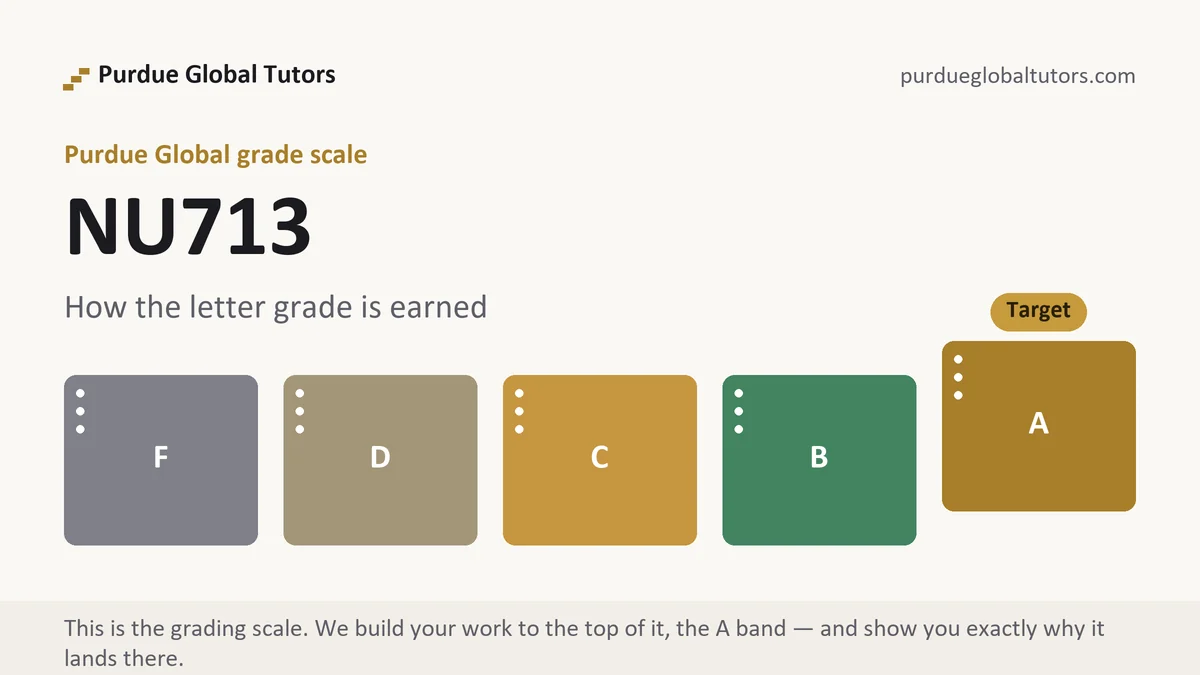
The boundary in this course is about data honesty rather than practice hours, but the wider DNP boundary still holds and is worth stating once: across this program, all supervised practice hours, sites, preceptors, and logs are the student's own, and we never touch them; our work is the written and analytic layer. In NU 713 that layer is the whole course. Every order runs the full machinery: rubric decoded row by row, a writer matched to population health work, a rubric QA pass, a separate APA and originality pass, and a check against the doctoral scale, where our grading guide records A, B, or F with everything under 80 failing.
In NU 713 right now?
Send the week and the rubric from Brightspace. First premium sample free, scale-checked, back in 24 to 48 hours.
Where NU 713 sits, and the older DN code
NU 713 is the current catalog code, five quarter credits, second of the nine courses NU 703 through NU 823 in the 50-credit DNP sequence for students who started before the 2026-2027 catalog; students starting under the 2026-2027 catalog take the new NU 702 through NU 806 sequence instead, where the nearest course is NU 704, Biostatistics, Epidemiology, and Social Determinants of Population Health. Its position matters: the population you analyze here often becomes the population your DNP project serves, and the strongest students treat this course as reconnaissance for the proposal they will write in NU 800. If you searched DN 713, that legacy code carries the same title, Epidemiology and Social Determinants of Population Health, inside the older DN doctoral set that continuing students are finishing; the analytic craft on this page holds for both, but prompts and rubric wording differ between the sets, so confirm which code your registration shows before you send work. There is no ExcelTrack module version of the DNP courses to weigh, so the only paths through this material are the two code sets, and the ten-week rhythm is the same in each.
Turn the rubric into a word budget before you write
Population health papers have a predictable failure: the determinants section, which is easiest to write, floods the paper, while the epidemiologic description, which carries the numbers and usually the weight, gets a thin page. Price the rows before drafting and the flood never starts.
Worked example on an illustrative points rubric (your section's own cap and rows set the real numbers). Say the analysis is capped at 1,350 words and graded out of 45 points: problem and population framing 6 points, epidemiologic description 12, social determinants analysis 12, data source appraisal 8, implications for practice 7. The cap divided by the total prices each point at 30 words. The framing row buys 180 words, one tight section, not the four-paragraph tour of the county most drafts open with. Description and determinants each buy 360, and the parity is the point: your numbers section must stand as tall as your narrative section. Appraisal buys 240, which surprises students who planned to dispatch it in three sentences; a 240-word appraisal names each source's design, coverage, and blind spots. Implications buys 210, enough for practice consequences, not enough for a second literature review. Percentages work the same way: divide the cap by 100 and spend words at the rate the row weight sets.
The parts of a population health analysis
Whatever your section titles the deliverable, the graded anatomy runs this way, and each part has a version that quietly fails.
| Part | What it has to establish | The version that loses points |
|---|---|---|
| Population and problem statement | Who, where, and which health outcome, bounded tightly enough to measure | A national problem claimed for a local paper, too broad for any denominator |
| Epidemiologic description | Named measures with denominators, periods, and comparisons that show the pattern | Percentages floating free of any population or year |
| Determinants analysis | Each determinant linked to the outcome through a cited mechanism | A list of social ills with no causal chain to the outcome |
| Data source appraisal | What each surveillance system or survey can and cannot support | All sources treated as equally authoritative because all are official |
| Implications for practice | What a DNP-prepared nurse could act on, at which level, with what measure of change | A call for awareness with no actor, level, or metric |
Citing data in an epidemiology paper
This course grades citation differently from an essay course, because the sources are datasets as often as they are studies. Four habits carry the grade. Give every rate its full address: measure, population, place, period, and source, in the same sentence the number appears; a prevalence of 11.6 percent means nothing until the reader knows among whom and when. Match verbs to designs with more care than usual, because determinants research is heavily cross-sectional: associated with and correlated with are earned, drives and causes almost never are, and a rubric row exists to catch the difference. Distinguish surveillance from research when you introduce a source, since a system that counts every reported case answers different questions than a survey that samples households, and the appraisal row wants you to say so. And prefer the primary table to the news summary of it: faculty check numbers against sources in this course more than in any other in the sequence, and a figure that drifted through a secondary source is a credibility wound the rest of the paper pays for.
Passing analysis, strong analysis
A passing NU 713 paper picks a real population, quotes defensible numbers, lists plausible determinants, and cites official sources. A strong one is built around a comparison: this population against a reference population, this decade against the last, this county against the state, because epidemiology without a comparison is just counting. Its determinants section reads as a mechanism, each link citable, from policy to exposure to outcome. Its appraisal admits what the data cannot show, and faculty reward that honesty visibly, because overclaiming is the discipline's cardinal sin. And its implications section names an actor and a lever: what a doctorally prepared nurse in this system could change, and which number would move if it worked. The strong paper reads like the first chapter of a DNP project, which is exactly what it often becomes.
Six mistakes that cost points here
- Numerators without denominators. Three hundred cases is not a rate; the row wants the population and period underneath every count.
- Causal verbs on cross-sectional data. A prevalence survey supports an association, and writing causes hands the appraisal row an easy deduction.
- Incidence and prevalence swapped. New cases and existing cases answer different questions, and misusing the terms signals the whole numbers section is unsafe.
- The unbounded population. A paper about Americans has no workable denominator; bound the population until a real dataset describes it.
- Determinants as a virtue list. Naming poverty, housing, and access without a cited path to the outcome earns sympathy and no points.
- Secondhand statistics. Numbers cited to a news story or a review rather than the originating system fail the source appraisal row on contact.
Questions NU 713 students ask
I have not touched statistics since my MSN. Can I survive this course?
Does the population I choose here matter for the rest of the DNP?
Are there practice hours in NU 713, and what would you handle if there were?
Where NU 713 sits in Purdue Global's programs
Open the exact program map for public curriculum context. Concentrations, select-one rows, transfer and electives make the current degree audit authoritative.
The units, one by one
The public Degree Plan verifies NU 713, while Brightspace controls Unit 1 through Unit 10. A Unit manual is added only from a verified real deliverable; the ten-week calendar never invents an assignment.