NU 800 (catalog code NU800), DNP Project Proposal, is the gate course of the Purdue Global doctorate: the document you produce here is the contract every later course holds you to. Its legacy counterpart is DN 723, the DNP Project Analytic Methods and Project Proposal course, the code older cohorts and transcripts print for the proposal slot. Six quarter credits across a ten-week term, weekly builds in Brightspace, live seminars, and a catalog-published range of 100 to 200 supervised practice hours embedded alongside the writing. The hours, the site relationship, and the logs are yours alone; the proposal itself is a long, structured argument, and that argument is what we help you build. This page maps how the proposal is graded, how to budget its sections before drafting, what each chapter has to prove, and the three questions NU 800 students send us most.
What NU 800 actually grades
A proposal is graded as a promise you can keep. Faculty read four things into it. First, a problem that is real, local, and measurable: not a national statistic pasted over your practice site, but a gap you can document where you are, framed in a question format your section specifies. Second, an evidence synthesis that earns the intervention, meaning the literature is appraised and argued into a conclusion rather than stacked in summary order. Third, a methods chapter that another clinician could execute without calling you: setting, participants, intervention steps, measures with named instruments, and an analysis plan matched to the data those measures produce. Fourth, feasibility, which is the quiet criterion that fails more proposals than weak citations do. A ten-week implementation window, an approval chain with real dates, and a site that has agreed in writing are all evidence of feasibility, and their absence reads as fiction.
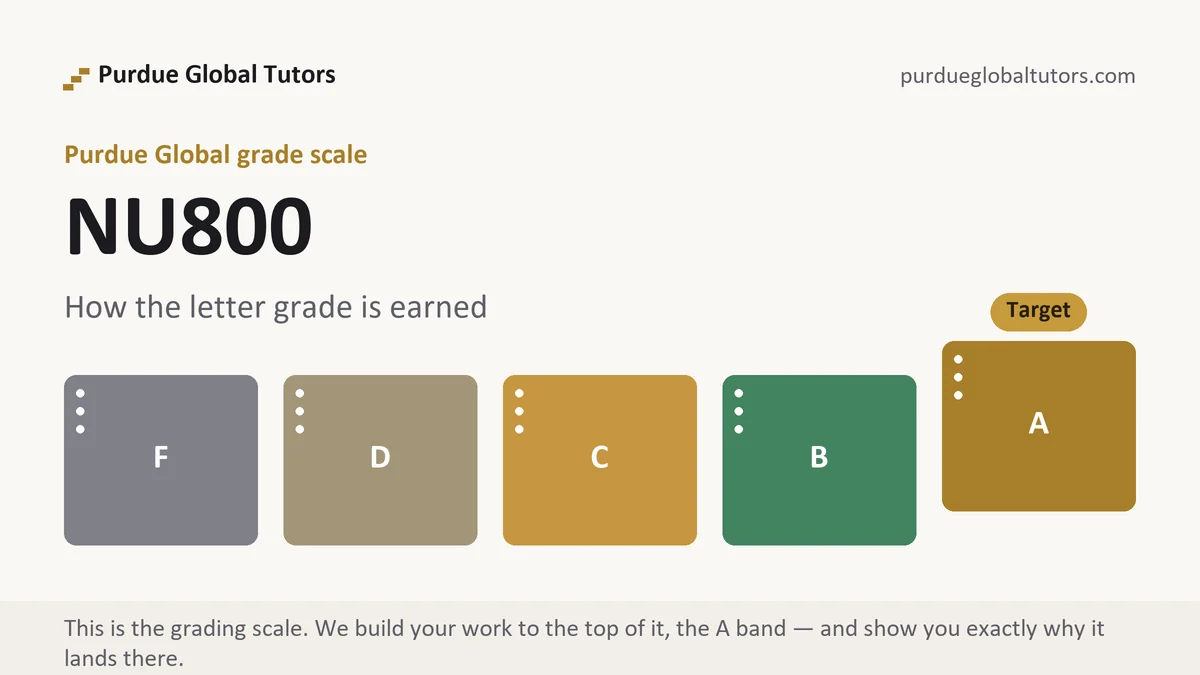
The rhythm is standard Purdue Global: a ten-week term on quarter credits, deliverables most weeks that build sections of the final document, discussion boards at doctoral register, and live seminars with an alternative written path when the time slot fails you. What is not standard is the scale. Doctoral courses grade A, B, or F, and everything under 80 fails, so a proposal chapter that would scrape by in a graduate course is a failing artifact here. Aim at 90 and build margin.
How we help in this course
Send the assignment brief, the rubric, and whatever exists so far: a problem statement, an evidence table, committee feedback, or nothing but the practice gap you have been circling. Drafts come back inside 24 to 48 hours at doctoral register, structured to your section's template, with the reasoning annotated so the revision conversation with your faculty advisor gets easier instead of harder.
The boundary in this course is worth stating plainly because NU 800 is where practice hours enter the program in force. The catalog publishes 100 to 200 supervised practice hours for this course, and every one of them belongs to you: we do not perform hours, contact your site or preceptor, complete or sign logs, or appear in any verification chain. What we build is the written layer that surrounds those hours, the proposal chapters, the appraisal tables, the measurement plan, the revision memos after committee feedback. Every order runs the full pipeline: rubric decoded row by row, a writer matched to doctoral project work, a rubric QA pass, a separate APA and originality pass, and a final check against the doctoral scale's 80 floor.
In NU 800 right now?
Send the week and the rubric from Brightspace. First premium sample free, scale-checked, back in 24 to 48 hours.
Where NU 800 sits, and the older code
NU 800 is course six of the nine-course DNP spine that runs NU 703 through NU 823 (students starting under the 2026-2027 catalog take the new project courses NU 802, NU 804 and NU 806 instead), and it is the hinge: NU 813 implements what this document proposes and NU 823 disseminates what NU 813 produced, so weak decisions made here get expensive twice. Students arriving from the legacy doctoral set sometimes search DN 723, DNP Project - Analytic Methods and Project Proposal, which is the older DN-prefix course covering similar territory for continuing students; the titles and rubric language differ between the two sets, so confirm the code on your registration before sending work. There is no ExcelTrack variant at the doctoral level, so the unit word is unit and the calendar is the ten-week term, full stop.
Turn the rubric into a chapter budget before you write
Proposals fail by imbalance more often than by error. The problem section is easy to write, so it swells; the methods chapter is hard, so it starves. Build the budget first. Copy the rubric rows into a blank document in grading order and convert weights to words before drafting a sentence.
Worked example on an illustrative rubric (your section's own cap and rows set the real numbers): a proposal draft capped at 1,200 words with six rows, problem and significance at 15 percent, review and synthesis of evidence at 25, theoretical or change framework at 10, methods and intervention design at 25, outcomes and measurement plan at 15, scholarly writing and APA at 10. The five content rows buy 180, 300, 120, 300, and 180 words. The writing row has no section of its own, so its 120 words fund the abstract, transitions, and the conclusion. Read what the budget just told you: your synthesis and your methods are each obligated to be longer than your problem statement, and the framework gets one disciplined paragraph, not a section of its own. If your section grades in points, divide the cap by the total: a 100-point rubric over 1,200 words prices each point at 12 words, which makes a 25-point methods row a 300-word commitment you can hold yourself to while drafting.
The parts of a DNP project proposal
Templates vary by section, but the argument underneath does not. Each part has a version graders reject on sight.
| Part | What it has to establish | The version that loses points |
|---|---|---|
| Problem and significance | A documented local gap, sized with site-level data, tied to a stated clinical question | National prevalence figures standing in for evidence that the problem exists at your site |
| Question or aim statement | Population, intervention, comparison, outcome, and time frame, each answerable within the program window | An aim so broad that no ten-week implementation could touch it |
| Evidence synthesis | Appraised studies argued into a conclusion that licenses this intervention | A serial book report: one paragraph per article, no comparison, no verdict |
| Framework | One named model, with each of its stages mapped to a concrete step of your project | A model summarized from a textbook and never mentioned again |
| Methods and intervention | Setting, participants, steps, and timeline written so a stranger could execute them | Process described in intentions, we will improve, rather than actions with owners and dates |
| Outcomes and measures | Each outcome paired with a named instrument, a collection point, and an analysis plan | Improvement promised with no instrument that could detect it |
| Ethics and approvals | Site permission, review determination, and data protections stated with dates | A sentence assuming approval that has not been requested |
Evidence craft in a proposal
The synthesis chapter is graded on hierarchy, currency, and argument, and each is visible fast. Hierarchy means the reader can tell what level each source sits at because your sentence says so: a systematic review of eleven trials carries a claim that a single descriptive study cannot, and the prose should price them differently. Currency matters because practice-change literature ages quickly; most sections set a five-year window, and an older source needs a stated reason to be present. Argument is the difference between a synthesis and an annotated bibliography: organize by finding, not by article, so one paragraph gathers everything the literature says about effect size, another gathers implementation conditions, another gathers measurement choices. Keep the appraisal table and the prose in strict agreement, because committees check them against each other, and give every statistic its context before it lands: a 40 percent reduction means nothing until the reader knows the baseline, the sample, and the setting it came from. Finally, cite forward into your own methods. When your intervention steps echo the conditions the strongest studies describe, say so with the citation attached; that single habit is what makes a proposal read as derived from evidence rather than decorated with it.
Passing proposal, strong proposal
A passing NU 800 proposal has all the parts, cites at doctoral density, and describes a project that could plausibly happen. A strong one is auditable. Its aim statement and its measurement table contain the same nouns, so nothing is promised that is not measured and nothing is measured that was not promised. Its framework does visible work, with each stage named at the point in the methods where it operates. Its timeline admits the approval gates and shows slack around them. And its limitations section arrives before the committee writes it for you, naming the small sample, the single site, and the short window, then explaining why the design still answers the question. Committees push back hardest on proposals that read as confident; they approve fastest the ones that read as honest.
Six mistakes that cost points here
- The borrowed problem. A nationally documented issue with no site-level data behind it invites the first committee question you cannot answer: how do you know it happens here?
- An unmeasurable aim. Improve staff knowledge fails; raise mean scores on a named instrument between two dated collection points survives.
- Synthesis by stacking. Ten sources summarized in sequence earn the evidence row partial credit at best; the row pays for comparison and verdict.
- The decorative framework. If the model could be deleted without changing your methods, the grader notices before you do.
- Methods written in hope. Every step needs an owner, a place, and a date; aspiration verbs are where feasibility credit dies.
- A timeline without gates. Site sign-off and review determination take real weeks; a plan that ignores them fails the feasibility read even when everything else holds.
Questions NU 800 students ask
NU 800 carries 100 to 200 practice hours. Do you have anything to do with those?
My site approval is stuck. Can the proposal still move?
Can you build the evidence appraisal table, or only the prose chapters?
Where NU 800 sits in Purdue Global's programs
Open the exact program map for public curriculum context. Concentrations, select-one rows, transfer and electives make the current degree audit authoritative.
The units, one by one
The public Degree Plan verifies NU 800, while Brightspace controls Unit 1 through Unit 10. A Unit manual is added only from a verified real deliverable; the ten-week calendar never invents an assignment.