NU 703 (catalog code NU703), Professional Role Development of the DNP-Prepared Nurse, opens the NU 703 through NU 823 DNP sequence and sets the writing register for the eight courses behind it. Older cohorts and transcripts print this opening slot as DN 703, Scientific Foundations for Practice Doctorate, the legacy DNP curriculum's opener under an adjacent numbering. The graded work is a doctoral role analysis: who the DNP-prepared nurse is inside a health system, argued from the professional literature rather than asserted from experience. The catalog also attaches a published range of 30 to 60 supervised practice hours to this course, and those hours, the site where they happen, and the logs that record them are yours alone; the writing that surrounds them is where we work. This page breaks down the rubric arithmetic, the shape of a role paper that reads at doctoral level, the citation habits that separate a pass from a strong grade, and the questions students bring us in week one.
What NU 703 actually grades
Three things, and none of them is clinical knowledge. The first is role argument: can you define the practice doctorate against the research doctorate, against the certified NP role you may already hold, and against the administrative roles the health system already staffs, using published position statements and role research rather than your own biography. The second is scholarly register at doctoral level, which is a step up from the MSN. Faculty reading a first DNP paper look for claims scaled to their sources, paragraphs that advance one idea each, and an authorial voice that synthesizes rather than reports. The third is planning: most sections attach an assignment that maps your intended practice focus and how the coming courses and their practice hours will build toward the DNP project, and that document is graded on specificity, not ambition.
The course runs on the standard Purdue Global frame: a ten-week term on quarter credits, six credits here rather than the usual five, deliverables due most weeks in Brightspace, discussion boards at doctoral register, and live seminars with an alternative written option when the live slot fails. Six credits in ten weeks means the reading load is real from week one, and the biggest paper usually lands in the back half of the term while the weekly work keeps arriving.
How we help in this course
Send the week, the prompt, and the rubric from Brightspace, plus anything your section added about the practice focus you intend to carry into the project courses. The work comes back inside 24 to 48 hours: role analysis built from the professional literature, the planning documents scoped to what your later courses actually require, discussion posts at doctoral register, and a walkthrough of the reasoning so the next paper takes you less time.
The boundary sits exactly where the catalog puts it. NU 703 carries a published range of 30 to 60 supervised practice hours, the first installment of the 1,000 postbaccalaureate hours the catalog requires for degree completion. Those hours are performed by you, at your site, under your preceptor, and recorded in your logs. We do not perform hours, contact sites or preceptors, complete or edit logs, or sign anything a program has to verify. What we build is the written layer around the hours: the papers, the plans, the reflections, and the reasoning. Every order runs the full machinery: rubric decoded row by row, a writer matched to doctoral nursing work, a rubric QA pass, a separate APA and originality pass, and a check against the doctoral scale before anything reaches you.
In NU 703 right now?
Send the week and the rubric from Brightspace. First premium sample free, scale-checked, back in 24 to 48 hours.
Where NU 703 sits, and the older DN code
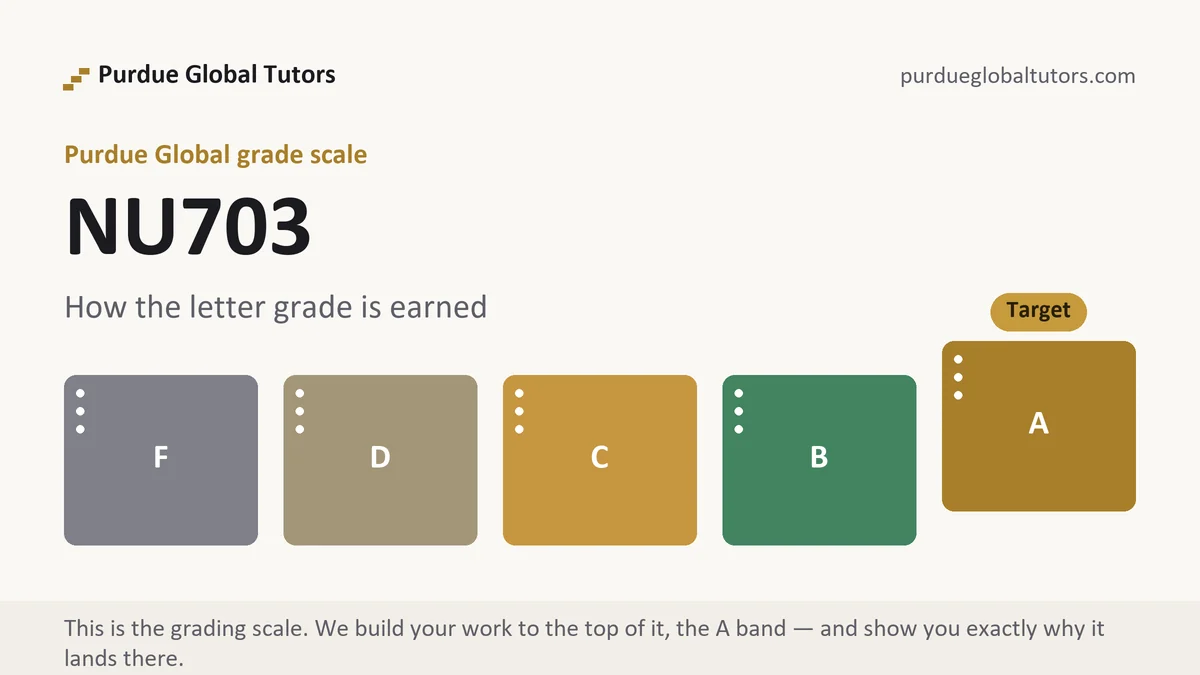
NU 703 is in the 2026-2027 catalog at six quarter credits, first of the nine courses NU 703 through NU 823 that make up the 50-credit DNP sequence for students who started before that catalog; students starting under the 2026-2027 catalog take the new NU 702 through NU 806 sequence instead, which opens with NU 702, Translating Evidence into Nursing Practice. The catalog also lists it as a core option on the MSN to DNP Path, the bridge for BSN-prepared nurses, so your classmates may be at two different points in their doctorates. Entry to the DNP itself is direct with an accredited MSN or through that bridge. If you came here searching DN 703, that is the legacy doctoral set: DN 703 carries the title Scientific Foundations for Practice Doctorate, a different emphasis under an adjacent number, and continuing students finish on the DN codes while new students take NU. The role development reasoning on this page transfers, but the two rubrics are not interchangeable, so confirm the code on your registration before sending work. One more grading fact, as our own grading guide records it: doctoral courses at Purdue Global run A, B, or F, and everything under 80 fails. There is no C to fall back on, which changes how much a single weak paper matters in a six-credit course.
Turn the rubric into a word budget before you write
Role papers fail by autobiography. The section about your own career writes itself, swells past its weight, and the synthesis rows starve. The fix is arithmetic before drafting: copy the rubric rows into a blank document in order and price each one in words.
Worked example on an illustrative rubric (your section's own cap and rows set the real numbers): say the role analysis is capped at 1,100 words across five rows: role definition and history at 20 percent, comparison of the DNP with other advanced roles at 20, application to your intended practice area at 25, integration of professional literature at 20, and organization with APA at 15. The first four rows buy 220, 220, 275, and 220 words. The mechanics row funds your introduction and conclusion, roughly 165 words between them, which caps the opening at a paragraph and kills the two-page wind-up most drafts start with. Notice that the application row is the largest single purchase: the paper is graded on what the role means in your setting, not on how well you can summarize its history. If your section grades in points, divide the cap by the total: a 55-point rubric on that same 1,100-word cap prices each point at 20 words, so a 12-point literature row is a 240-word obligation you can check before submitting.
The parts of a doctoral role analysis
Sections name this deliverable differently, but the graded anatomy is stable, and each part has a weak version faculty see every term.
| Part | What it has to establish | The version that loses points |
|---|---|---|
| Framing of the practice doctorate | What the DNP is and why it exists, argued from published sources | A history of nursing education recited without an argument |
| Role comparison | DNP against PhD, against the certified NP role, against administrative roles, on named dimensions | A list of degrees with no dimensions of comparison |
| Application to a practice area | The specific problems in your setting a DNP-prepared nurse is positioned to own | A resume paragraph about the author instead of an analysis of the role |
| Literature integration | Position statements, role research, and workforce data doing distinct jobs | Every claim resting on one association document |
| Forward plan | How this course's plan connects to the project sequence and the hour requirement | Vague intentions with no named courses, settings, or milestones |
Citing evidence in a role paper
Role papers pull from three source families, and the grade depends on keeping their jobs separate. Professional association documents, the Essentials and position statements, establish what the role is supposed to be; they are authority claims, and the verb should say so: the document calls for, defines, positions. Role research, surveys and outcome studies of DNP-prepared nurses in practice, establishes what actually happens, and it deserves the same discipline as any study: name the design and the sample before the finding, and keep the verb observational, since a survey of 400 DNP graduates supports reported and described, not proved. Workforce and policy data, employment projections and system-level reports, establish scale, and every number needs its denominator and its year before the percentage lands. The most common citation failure in NU 703 is a paper where an association document is asked to do all three jobs, defining the role, proving its impact, and sizing the market, on the strength of one citation repeated eight times. Spread the load, and let the reader see which family each sentence is drawing from.
Passing paper, strong paper
A passing NU 703 paper defines the role accurately, compares it to the alternatives, cites the expected documents, and holds APA together. Nothing in it is wrong, and under a scale where everything below 80 fails, that is not nothing. A strong paper makes a claim the reader could dispute: that the practice doctorate matters for a specific reason in a specific setting, and here is the evidence arranged to show it. Its comparisons run on named dimensions, preparation, focus, accountability, rather than on adjectives. Its application section reads like the writer has already chosen the problem their DNP project will chase, because the strong writers usually have. And its plan names courses, settings, and dates. Faculty read this paper as a forecast of the doctorate to come; the strong version tells them the project sequence will go well.
Five mistakes that cost points here
- The autobiography paper. Your career is evidence for one section, not the spine of the argument; graders want the role analyzed, not the author introduced.
- MSN register in a doctoral course. Reporting what sources say without synthesizing across them reads one degree lower than the rubric grades.
- One-source dependence. Eight citations to a single association document counts as one voice, and the literature row prices it that way.
- A plan without particulars. The forward-plan assignment is graded on named settings, populations, and milestones, not on commitment to excellence.
- Ignoring the scale. A 79 in a doctoral course is an F; budget effort per assignment as if every deliverable is load-bearing, because here it is.
Questions NU 703 students ask
What happens with the 30 to 60 practice hours attached to this course?
I found DN 703 with a different title. Which course am I actually in?
How is a doctoral paper graded differently from my MSN work?
Where NU 703 sits in Purdue Global's programs
Open the exact program map for public curriculum context. Concentrations, select-one rows, transfer and electives make the current degree audit authoritative.
The units, one by one
The public Degree Plan verifies NU 703, while Brightspace controls Unit 1 through Unit 10. A Unit manual is added only from a verified real deliverable; the ten-week calendar never invents an assignment.