NU 576 (catalog code NU576) brings the FNP and AGPCNP tracks back together for one focused population course, women's health across the reproductive years and beyond, and its written work turns on decisions that have more than one right answer. The deliverable most sections weight heaviest is the shared decision-making case paper: a patient choosing among contraceptive methods, weighing menopausal symptom management, or facing a screening interval question where issuing bodies disagree, and a write-up that presents the medically eligible options, applies the patient's own priorities, and documents a decision the patient made with you rather than received from you. NU 577, the clinical, follows directly. This page covers the rubric arithmetic, the case paper's anatomy, the citation habits this specialty demands, and the questions students raise most.
What NU 576 actually grades
Four things, and the first is eligibility reasoning. Much of women's health prescribing runs on published eligibility frameworks, medical conditions crossed against methods, and the rubrics reward papers that work the framework visibly: this patient's migraine history or blood pressure or postpartum status, the category it lands her in for each candidate method, and the options that survive. Second is the counseling conversation, graded here as writing that presents surviving options with honest efficacy and side-effect profiles at patient register, because in this specialty the deciding often belongs to the patient and the paper must show the clinician making that possible. Third is history taking specific to the population, menstrual, obstetric, and sexual history taken without euphemism and used rather than filed, plus the safety screening this course expects in every encounter write-up. Fourth is management across the reproductive arc, since a term will move you from contraception through preconception counseling to perimenopausal symptom management, and the rubric expectations shift register with each stop.
The delivery is standard Purdue Global: a ten-week term on quarter credits, deliverables most weeks, discussion boards at graduate register, live seminars in Brightspace with the written alternative available when the hour fails. Both tracks sit in the same sections here, so the case load stays population-focused rather than track-flavored.
How we help in this course
Send the week, the case prompt, and the rubric from Brightspace, plus any eligibility framework or guideline your section names. The paper comes back inside 24 to 48 hours with the eligibility work shown method by method, the counseling section written at patient register with efficacy numbers in honest form, the safety screening documented, and a walkthrough of the decision logic so the pattern transfers to the next case.
The boundary that never moves applies with its usual force. NU 577, the clinical paired to this course, involves precepted hours in women's health settings, and those hours, encounters, site arrangements, and logs are the student's own. We do not perform or attend clinical activity, contact preceptors or sites, complete or edit hour logs, or sign anything a program verifies. The written layer is what we build: case papers, counseling write-ups, discussion posts, seminar alternatives, and study material for the population. Every order runs the full machinery, rubric decoded row by row, a writer matched to women's health coursework, rubric QA, a separate APA and originality pass, then the check against the graduate scale your section grades on.
In NU 576 right now?
Send the case and the rubric from Brightspace. First premium sample free, scale-checked, back in 24 to 48 hours.
Shared course, paired clinical, and the MN 576 legacy code
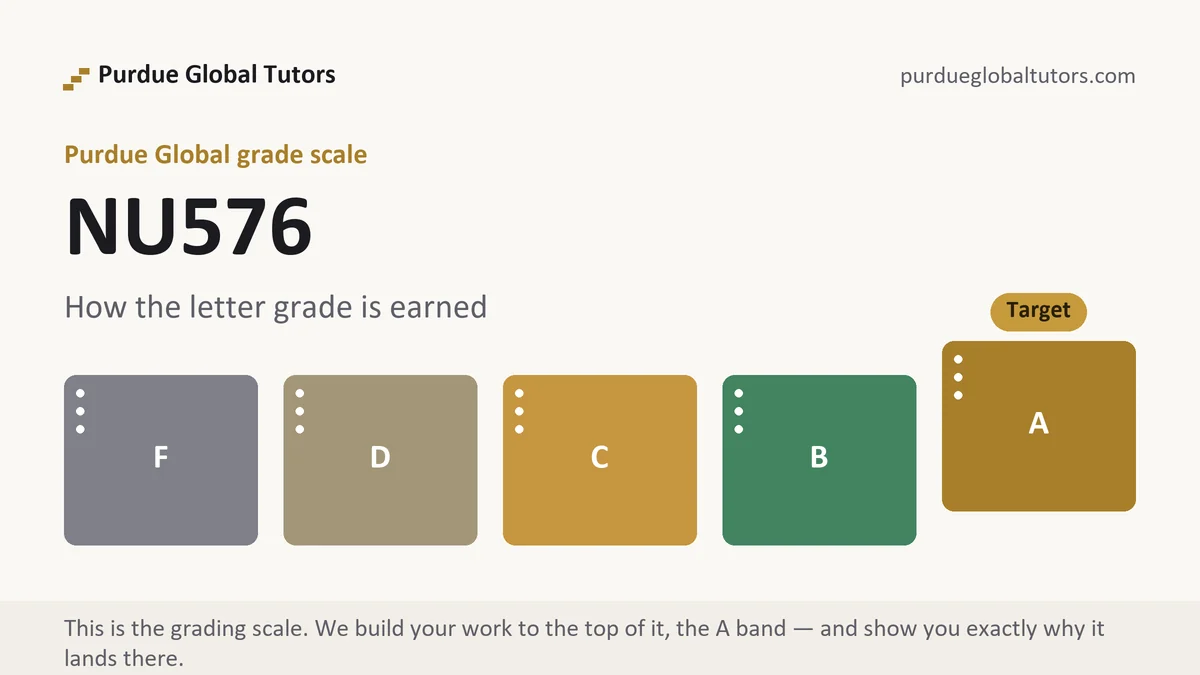
NU 576 sits at sequence position seven for both primary care tracks, the point where FNP students arriving from NU 568 and AGPCNP students arriving from NU 572 converge on one population. It pairs with NU 577, NP II Clinical - Women's Health Focus, at position eight, and the didactic-then-clinical rhythm means the case types you write here are the encounter types your precepted hours will echo. After the pair, the tracks fork again, FNP into NU 580 and pediatrics, AGPCNP into NU 584 and the frail elderly. The legacy code is MN 576 with the same title, still in the catalog for continuing students, and this page's reasoning holds for it while the rubric wording will not, so send the rubric your section published. On scale, our grading guide records graduate courses passing at 70 with a C band running 70 to 79.99, worth keeping in view in a course where two or three case papers carry most of the weight.
Turn the rubric into a word budget before you write
The characteristic bloat in this course is the options tour: students describe every contraceptive method or every symptom therapy at equal length, the paper becomes a textbook chapter, and the patient disappears from her own case. The rubric almost never pays for the tour, so price the rows before you draft.
Worked example on an illustrative rubric (your section's own cap and rows set the real numbers): a decision-making case paper capped at 2,000 words with five rows: focused history and safety screening at 15 percent, eligibility assessment at 25, options counseling at 30, the documented plan at 20, writing and APA at 10. The content rows buy 300, 500, 600, and 400 words. The budget's message is blunt: eligibility and counseling together own more than half the paper, and they are precisely the sections first drafts treat as connective tissue between the history and the plan. Within the 600-word counseling row, three surviving options at roughly 150 words each, efficacy in absolute terms, the main side effects, the practical demands of the method, leaves 150 words for the patient's stated priorities doing the sorting. If your section grades in points, divide as usual: a 50-point rubric on 2,000 words prices each point at 40, so a 5-point safety screening row is a 200-word obligation, which is a real paragraph, not a checkbox line.
The anatomy of a shared decision-making case paper
Labels vary by instructor; the graded ground does not. Each part below has a version graders mark down on sight.
| Part | What it has to establish | The version that loses points |
|---|---|---|
| Focused history | Menstrual, obstetric, and sexual history in clinical language, plus the medical items that will drive eligibility | Euphemism, gaps in the obstetric line, or history collected but never used |
| Safety screening | Intimate partner violence and related screening documented with the tool or approach named | Omitted entirely, the single most flagged absence in this course |
| Eligibility work | Each candidate option crossed against this patient's conditions, with the category stated and the failures excluded | Options presented as universally available with the framework nowhere visible |
| Options counseling | Surviving options at patient register with efficacy in absolute terms and the method's practical demands | A textbook tour of every method the field contains |
| Patient priorities | What this patient said she cares about, applied visibly to sort the options | The clinician's preference presented as the patient's |
| Documented decision | The chosen plan, initiation details, backup instructions, and the revisit trigger | A method named with no start logistics and no failure plan |
| Follow-up thread | When she returns, what gets checked, and what would change the plan | Return as needed |
Citation craft where the bodies disagree
Women's health is the specialty where major issuing bodies disagree most visibly, on screening start ages, on intervals, on management thresholds, and NU 576 graders treat how you handle the disagreement as a graded skill. Name both positions when a real one exists, then choose and give the reason, because presenting a contested recommendation as settled reads as a research gap and adjudicating it reads as clinical judgment. Anchor eligibility claims to the framework itself, cited by name and year in the sentence, since eligibility category assignments are lookups a grader can check, and an unattributed category is an unsupported claim. Report efficacy in absolute terms with the use-condition attached, because perfect-use and typical-use numbers can sit far apart and counseling that quotes only the flattering one misrepresents the method; papers get flagged for exactly this. And date-check everything in this specialty before it goes in, because screening intervals and management guidance here have moved within recent memory, and a superseded interval in your plan section is the kind of error that costs points on two rows at once, evidence and plan together.
Passing paper, strong paper
A passing NU 576 paper collects the right history, avoids ineligible options, and lands on a defensible plan. A strong paper is distinguishable in three places. Its eligibility section shows the crossings, condition by condition, category by category, so the surviving options list is a conclusion the grader can audit rather than an assertion. Its counseling section sounds like a clinician talking to a patient, absolute numbers, honest trade-offs, the practical texture of each method, and you can locate the patient's own priorities doing the final sorting, which is the difference between shared decision-making and a recommendation wearing its costume. And its documented plan is executable: initiation timing, backup coverage, side-effect counseling, and a named trigger for return. The weak version of this paper reads as a chapter about methods; the strong version reads as one patient's decision, fully supported, and graders in this course can tell them apart by the end of the eligibility section.
Six mistakes that cost points here
- Safety screening skipped. Sections treat it as mandatory in every encounter write-up, and its absence is the most reliable deduction in the course.
- Eligibility invisible. Options offered without the framework crossing shown, so the grader cannot tell filtered from lucky.
- The methods tour. Equal words for every option, including the ineligible ones, with the patient's case waiting at the end.
- Perfect-use numbers alone. Efficacy quoted in its flattering form without the typical-use figure reads as counseling malpractice on paper.
- The clinician deciding. A plan that never shows the patient's priorities sorting the options fails the row the paper is named for.
- Contested guidance presented as settled. Where bodies disagree, picking silently loses the evidence points that naming and adjudicating would have earned.
Questions NU 576 students ask
I am on the AGPCNP track. Why am I in a course with the FNP students again?
My case involves a pregnant patient. Is that in scope for this course's help?
Two guidelines give different screening intervals for my case. Which one do I write to?
Where NU 576 sits in Purdue Global's programs
Open the exact program map for public curriculum context. Concentrations, select-one rows, transfer and electives make the current degree audit authoritative.
The units, one by one
The public Degree Plan verifies NU 576, while Brightspace controls Unit 1 through Unit 10. A Unit manual is added only from a verified real deliverable; the ten-week calendar never invents an assignment.