Purdue Global's Adult-Gerontology Primary Care NP track is a 60-credit concentration inside a 90-quarter-credit MSN: the six-course graduate core, then a twelve-course specialty sequence that opens with the three advanced sciences and alternates didactic and clinical from NU 572 AGNP I to the NU 610 final clinical. Didactic weeks on the traditional path carry an assignment, a discussion board, and a live seminar in Brightspace, graded cumulatively on the graduate scale where anything under 70 fails. The catalog prints no clinical-hour totals for this track, so planning runs on your placement calendar instead. Written deliverables come back in 24 to 48 hours, drafted in documentation register, with the whole term mapped before week two.
The track, from the core to NU 610
The first 30 credits are the graduate core every MSN student walks through: NU 501 Advanced Nursing Roles, NU 502 Theoretical Foundations of Advanced Practice Nursing, NU 504 on evidence-based practice, NU 505 Clinical Epidemiology and Population Health Promotion, NU 506 on health policy and law, and NU 507 Promoting Optimal Models and Systems for Health Care Delivery. Five quarter credits each, argument-driven, and the register you build here, claims carried by evidence rather than experience alone, is the register the specialty courses will assume you already own.
The concentration itself is twelve courses at five credits each, 60 on the nose. It opens with the sciences trio, advanced physiology and pathophysiology (NU 551), health assessment and diagnostic reasoning (NU 552), and pharmacotherapeutics (NU 553). Then NU 566, NP I - Introduction to Primary Care for the Nurse Practitioner, and the population work begins. Several of the didactics are shared with the FNP track, NU 566 itself, NU 576 on women's health, and NU 605 near the end; the courses that make this degree adult-gerontology are NU 572, AGNP I - Primary Care of the Adolescent and Adult, and NU 584, AGNP II - Primary Care of the Frail Elderly. The same twelve-course run is also packaged as a postgraduate certificate, which the catalog notes is not offered in every state.
The didactic-clinical pairs, and the unnumbered hours
From NU 572 forward the sequence moves in pairs: NU 572 then NU 573, AGNP I Clinical - Adolescent and Adult Focus; NU 576 then NU 577, NP II Clinical - Women's Health Focus; NU 584 then NU 585, AGNP II Clinical - Frail Elderly Focus; and at the end NU 605, Transition to Practice, sitting beside NU 610, NP III Clinical - Primary Care Focus. Here is the planning problem the catalog hands you: it does not print hour counts for these clinical courses, and Purdue Global's own program pages send that question to an advisor. So the governing document for your term is not a published number, it is your confirmed placement schedule, and that is the document we build the writing plan around. The hours, the preceptor who signs for them, and the logs that record them are entirely yours. The graded writing wrapped around them, case work, boards, papers, reflections, is the part we carry.
NU 605 deserves its own sentence. Transition to Practice closes the didactic side while NU 610 runs the final clinical, and the pairing lands exactly when fatigue peaks. Students under-budget it because the finish line is visible from there; the workload does not care what is visible.
Ten weeks, run as arithmetic
A traditional term is ten weeks, and a didactic week is a three-item bundle: one graded assignment, one discussion board, one live seminar. One course is therefore ten assignments, ten boards, and ten seminars. Put a didactic beside its clinical twin and the same 70 days must also hold your placement schedule, which the catalog declined to size for you. Two didactics at once doubles the count to 40 graded items and 20 live sessions before a single clinical hour is worked. None of this is hard individually; all of it is simultaneous, and simultaneity is what the term map is for.
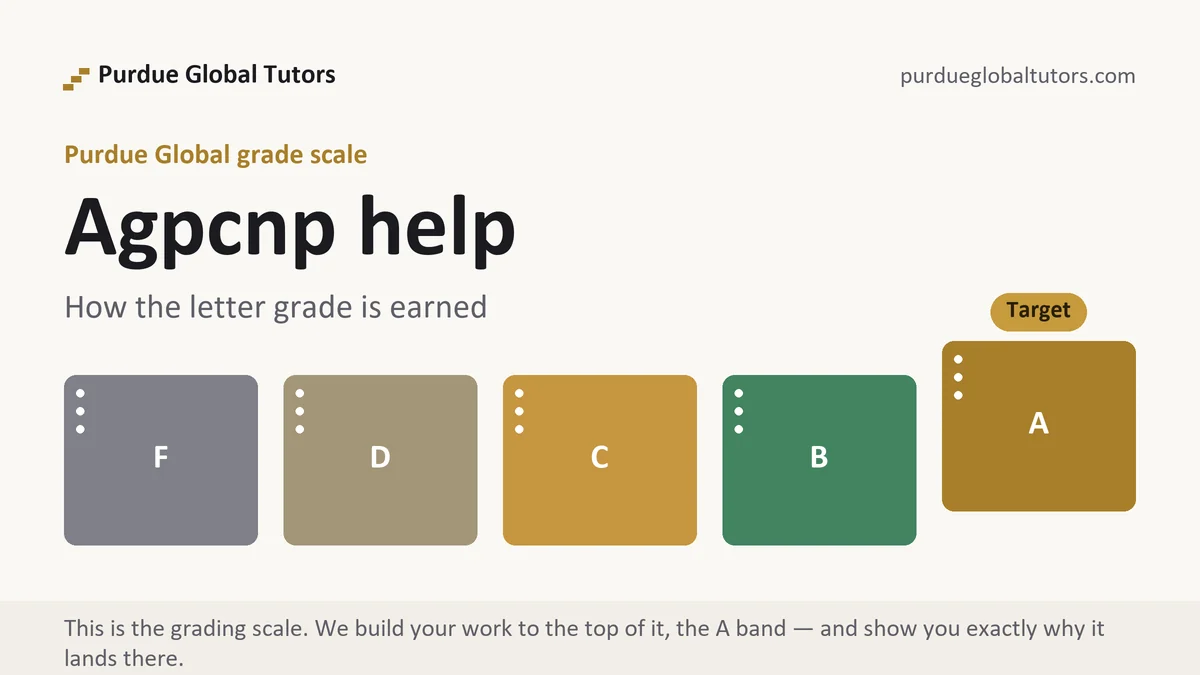
Now the grade math, with every week weighted equally for the arithmetic. The graduate scale fails below 70, holds its C band from 70 to 79.99, and pays a B at 80. Open NU 584 with three weeks averaging 72 and you have banked 216 of the 800 points a B-average finish requires; the remaining seven weeks must average just under 84. The A line is harsher: 900 minus 216 leaves 684, nearly 98 per remaining week, which is arithmetic fiction on a working nurse's calendar. The lesson is not that a slow start is fatal. It is that week three is when a term is still cheap to fix, so we run your standing after every returned grade and the number stays known instead of felt.
A pair term, run week by week
-
Week zero: two documents
The syllabus and your placement schedule arrive in chat. The ten units get mapped against your clinical days, the heavy assignments get flagged early, and the live seminar hour is marked immovable before anything is drafted.
-
Each unit: drafts land ahead of site days
The assignment and the board post come back 24 to 48 hours after you send the rubric, and always ahead of that week's placement days, so the evening after a clinic day is for reading a draft, not producing one.
-
Runway arithmetic, stated once
Count backward from any deadline: a 48-hour drafting window plus a day for you to personalize the draft and check the sources means the request leaves your phone three days out. Anything inside that window is a short-runway job and gets called one honestly, not promised casually.
-
After each grade: the standing updates
Every returned score reruns the term math above, so you always know what the remaining weeks must average on the graduate scale, and whether the plan holds or needs to tighten.
In the AGNP sequence right now?
Send the course code, the unit, and the rubric. Documentation-register drafts, first premium sample free.
Three arrangements, priced in tradeoffs
| Arrangement | What you hand over | It wins when | What it costs you |
|---|---|---|---|
| A single deliverable | One assignment or board post with its rubric | The term is healthy and one week collapsed | Cheapest and cleanest, and it protects nothing beyond itself. The next collision starts from zero, and you remain the calendar's only manager. |
| The didactic twin | The full written side of a pair term: NU 572 while NU 573 runs, NU 584 beside NU 585 | Placement weeks are eating the exact evenings the didactic needs | The strongest protection on the weeks that decide the degree, but the off-pair terms, core and sciences, stay unguarded, and unguarded terms are where averages quietly sink. |
| The whole-term map | Both syllabi plus your placement calendar, sent in week one | Two courses share a term with clinical days and nothing can be allowed to land unplanned | The largest commitment, and a real dependency: lean on the schedule without reading the margin notes and you have rented a calendar instead of learning a register. |
The honest reading cuts both directions. Buy too little coverage and the arithmetic above happens to you one surprise at a time. Buy the full map and skip the rubric notes each draft carries, and the dependency compounds instead of shrinking. Students who read those notes tend to need less of us each term, which is the version of this arrangement we would rather sell twice than once badly.
The mistakes that actually cost grades here
- Letting the didactic twin idle through placement weeks. The clinical course feels like the term's real work, so NU 572 drifts to a 68 while the hours get done. The transcript records both courses at equal weight and no sympathy.
- Writing AGNP case work in core-course essay voice. NU 572 and NU 584 score a documentation chain, findings to differential to plan to follow-up, and a beautifully argued essay that skips the chain loses to a plain draft that walks it.
- Treating boards as optional on hard weeks. Cumulative grading means a skipped board is not deferred, it is deleted. Those are the cheapest points in the bundle and the first ones tired students abandon.
- Booking clinical days over the seminar. The seminar is live. A placement schedule built without it turns a graded-adjacent hour into a weekly conflict that no draft can fix.
- Discovering the standing in week eight. Run the recovery arithmetic in week three, when an 84-average fix is possible, not in week eight, when the same equation returns numbers nobody can post.
What stays yours, always
Four things never move across the table. Clinical hours: we neither perform nor pad them. Preceptors and sites: we contact nobody, arrange nothing, and sign nothing. Logs and evaluations: records of your practice get written only by you and the people who watched you practice. Your Brightspace login: you submit your own work from your own account, every time. And one commitment running the other way: if the gradebook says a course cannot clear 70 on the weight remaining, you hear that as arithmetic, with a retake plan attached, not after another invoice. Every draft passes a rubric check and a separate originality pass before delivery, and it is delivered to you alone.