NU 300 (catalog code NU300), Professional Leadership Transitions, is a six-credit writing course about who you are becoming as a nurse, and it grades argument, not biography. The deliverables, role papers, leadership self-assessments, professional development plans, are scored on whether you can name a leadership framework, hold your own practice up against it honestly, and commit to specific, dated goals. Purdue Global places the course at a hinge point, it sits in the ASN major and opens the RN-to-BSN grid, so graders read it as your entry into baccalaureate-register writing, and the fastest way to lose points is to hand in feelings where the rubric asked for a framework.
What NU 300 actually grades
Three moves, repeated across the term. First, framework literacy: transformational leadership, professional standards, scope-of-practice documents, quoted accurately and applied rather than name-dropped. Second, honest self-location: the assignments ask where your practice actually stands against those frameworks, and rubric rows reward specific evidence from your own work history over flattering generalities. Third, a plan: goals that carry a measure and a date, because a development plan without either is a wish. At six quarter credits this course is heavier than it looks, and the weekly rhythm, written assignments, discussion boards, live seminars, runs all ten weeks without a light one.
The course carries no clinical companion, so unlike most of the nursing sequence, everything graded in NU 300 is on paper, which is exactly why it responds so well to writing support.
How we help in this course
Send the week's prompt and rubric from Brightspace along with a short paragraph about your actual nursing background, your setting, your years in, one honest strength, one honest gap, because role papers grade better when they are anchored in a real practice rather than a generic one. Drafts return with the framework named early, your experience mapped against it point by point, and goals written in measurable form. Where a prompt asks for reflection, the draft holds the professional register: first person, but argued, with sources carrying the claims your story illustrates.
Each order moves through the same pipeline described across this site: rubric rows decoded before a word is drafted, a nursing writer, a rubric fit check followed by an independent APA and originality review, the score checked against the 75-floor nursing scale, and delivery within 24 to 48 hours.
In NU 300 right now?
Send the prompt and the rubric from Brightspace. First premium sample free, scale-checked, back in 24 to 48 hours.
A reflective course that still fails at 74.99
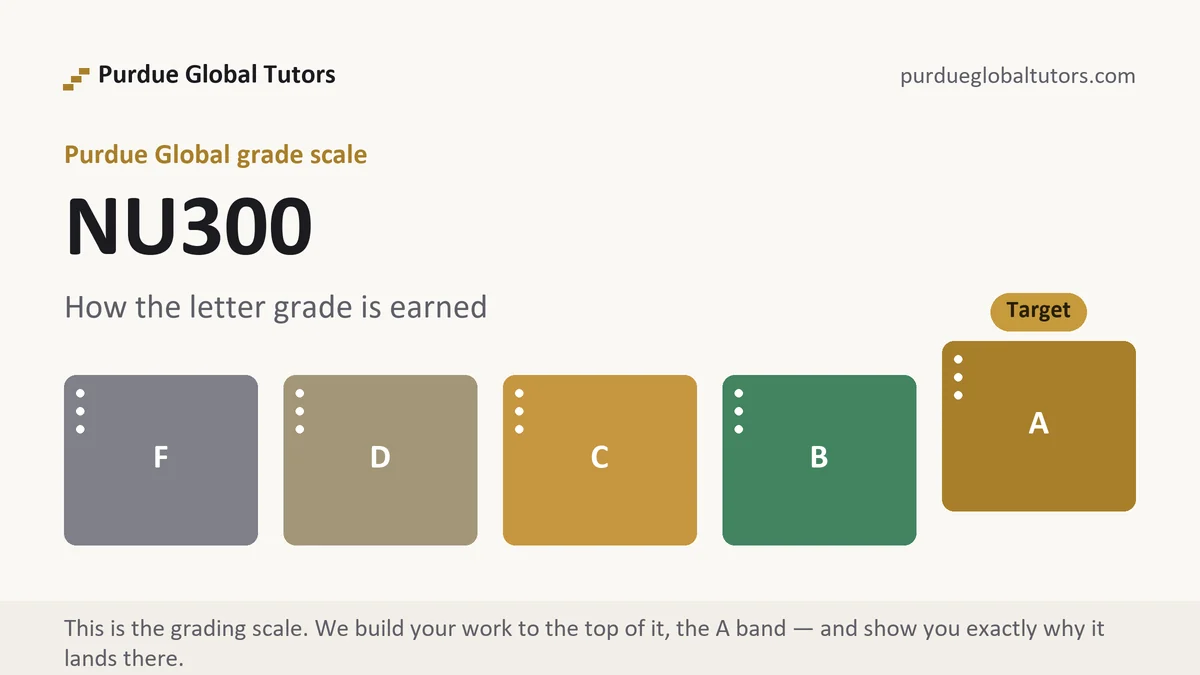
Because the content is professional identity rather than pathophysiology, students walk into NU 300 expecting a soft grade, and the scale disagrees. This is a School of Nursing undergraduate course: the passing floor is 75, the C band runs only to 76.99, and the A opens at 93. For RN-to-BSN students it is often the first Purdue Global course after years away from school, ten weeks on quarter credits, weekly deliverables plus a live seminar, all while working shifts. The trap is specific to this course: reflective prompts feel easy, so they get written last and fast, and a string of 78s from rushed reflection papers sits close enough to the floor that one bad week turns the term into recovery arithmetic. Treat the writing as the whole grade, because here it is.
Turn the rubric into a word budget
An illustrative NU 300 role transition paper caps at 1,200 words and grades on four rows: professional self-assessment at 30 percent, application of a leadership framework at 30, the development plan at 25, and organization with APA at 15. Multiply the content rows against the cap: 360 words for the self-assessment, 360 for the framework work, 300 for the plan, leaving 180 from the writing row to fund the introduction and the close. Those numbers discipline the two failure modes this course produces: the memoir, where self-assessment swallows the paper and the framework gets a cameo, and the book report, where the framework is summarized at length and you never appear in it. Equal budgets mean the rubric wants them interleaved, your evidence read through the framework's categories, paragraph by paragraph.
The plan's 300 words divide naturally at three goals: each gets its statement with a measure and a date, the resource it depends on, and the barrier you expect. If your section grades on points, divide the cap by the point total and budget words per point, then keep the ratio between the three content rows intact.
The parts of a role transition paper
Whether the week calls it a transition paper, a leadership analysis, or a development plan, the graded skeleton is consistent.
| Part | What it has to establish | The weak version graders see |
|---|---|---|
| Current role snapshot | Your setting, scope, and responsibilities, stated plainly as the baseline | A resume paragraph with no analytic purpose |
| Framework declaration | The leadership model or standard you will measure against, defined from a source | A famous name dropped once and never used |
| Mapped self-assessment | Your practice held against each element of the framework, with real incidents as evidence | Strengths and weaknesses listed free of any structure |
| Gap statement | The specific distance between your current practice and the target role | I hope to grow as a leader, unlocated |
| Development plan | Two to four goals, each with a measure, a date, a resource, and a barrier | Goals without numbers or calendars |
| Professional close | What changes first, and how the plan will be revisited | A restated introduction |
Evidence craft for professional-identity writing
Papers about your own role still run on sources, and the sourcing rows here have their own discipline.
Design and sample first, even for workforce claims. Statements about nurse leadership and outcomes usually trace to observational studies; say so before the finding. A survey of 1,900 staff nurses can report what it measured, and naming the instrument is one clause, not a paragraph.
Association is not causation, especially about leadership. The literature linking leadership styles to retention or satisfaction is almost entirely observational, so the honest verb is was associated with. Claiming a style improves retention asserts an experiment that rarely exists, and instructors in framework courses check exactly this.
Rates need denominators and windows here too. Turnover per 100 nursing positions per year is a checkable figure; high turnover is a mood. When your gap statement or plan cites workforce numbers, keep the base and the period attached.
Quote standards, cite editions. Scope-of-practice language and professional standards documents are revised on cycles, and a framework row loses credibility when the edition cited is two revisions old.
Passing work, strong work, in NU 300
Passing work tells a sincere story and gestures at a framework. It reads pleasantly, its goals are worthy, and the grader can find nothing to mark except that the framework and the story never actually touch, which is where the two biggest rows quietly shed points.
Strong work is built as an argument. The framework's categories become the paper's headings or its paragraph logic, every claim about yourself is paired with an incident that shows it, the gap statement is one sharp sentence rather than a paragraph of modesty, and the goals are so specific that a stranger could check them on the stated date. Strong work also resists the urge to present a finished leader: rubrics in transition courses reward accurate self-location, and a paper with no genuine gap has nothing for its own development plan to do.
Five mistakes that cost points here
- The memoir. Vivid experience, no framework. The largest rows want your story read through a model, not instead of one.
- The book report. The model summarized for pages while your own practice never enters the analysis.
- Goals without measures or dates. Become a better communicator cannot be scored. Attach the number and the calendar.
- Casual register. First person is expected; conversational looseness is not. This course is the audition for baccalaureate writing.
- Recycling one anecdote. Using the same incident as evidence for every framework element reads as a thin practice history, even when it is not.
Questions NU 300 students ask
I am an RN-to-BSN student and this is my first course back. Is NU 300 a hard start?
The prompt says to use a leadership theory but does not name one. Which should I pick?
Can you write the self-assessment parts if I have limited nursing experience?
Where NU 300 sits in Purdue Global's programs
Open the exact program map for public curriculum context. Concentrations, select-one rows, transfer and electives make the current degree audit authoritative.
The units, one by one
The public Degree Plan verifies NU 300, while Brightspace controls Unit 1 through Unit 10. A Unit manual is added only from a verified real deliverable; the ten-week calendar never invents an assignment.