Purdue Global's Associate of Science in Nursing is the university's pre-licensure degree: 116 quarter credits, 45 in general education core and 71 in the nursing major, run on ten-week terms with weekly deliverables and live seminars in Brightspace, graded on the School of Nursing undergraduate scale where anything below 75 fails. Every major course splits into a theory half and an on-ground clinical companion, NU 140 beside NU 140CL and so on down the grid. We support the theory half only: assignments, discussion boards, seminar prep, and study kits from NU 104 through the NU 298 capstone, drafted to A-band standard within 24 to 48 hours. The clinical half, hours, skills, sites, and logs, stays entirely yours, and the exact line is stated plainly below.
The degree, mapped
The 116 credits split 45 core and 71 major, and the major itself splits again: 44 didactic credits you can be tutored through and 27 clinical credits nobody can do for you. The didactic ladder starts with the two five-credit foundations, NU 104 Pathophysiology for Nursing and NU 145 Psychology Across the Lifespan, adds NU 140 Nursing Fundamentals and the four-credit NU 141 Pharmacology for Nursing, then climbs the specialty row: NU 142, NU 144, and NU 263, Medical-Surgical Nursing I through III, with NU 143 Maternal Infant Nursing, NU 225 Pediatric Nursing, and NU 245 Mental Health Nursing between them, three credits each. NU 298 Capstone closes the associate work, and NU 300 Professional Leadership Transitions, six credits and the only 300-level course in the grid, points the degree at the RN-to-BSN beyond it. One honesty note before anything else: this program is pre-licensure with a small footprint, Iowa and Maine at our last catalog check, and enrollment is limited, so confirm eligibility with the university before you plan anything around it.
Theory beside clinical, and the line between them
Almost every course above carries a CL twin, NU 140CL through NU 298CL, and the CL side is facility-based patient care arranged by the school. So the boundary, stated as plainly as we can write it: we never complete clinical or practicum hours, never find or contact preceptors, coordinators, or sites, and we do not prepare placement paperwork, put a signature on it, or fill an hour log, a skills checkoff, or an attendance record. Those documents certify what you personally did in a building we have never entered, and a licensure program is exactly the wrong place to blur that. We also never ask for PG Campus or Brightspace credentials; submission happens from your account, by you. What the team does own is the written half of the same weeks: the assignment, the board post, the seminar prep, the pathophysiology reasoning that makes the clinical day make sense. The facility hours are yours; the writing that surrounds them is what we carry.
Ten-week arithmetic, done before the term does it to you
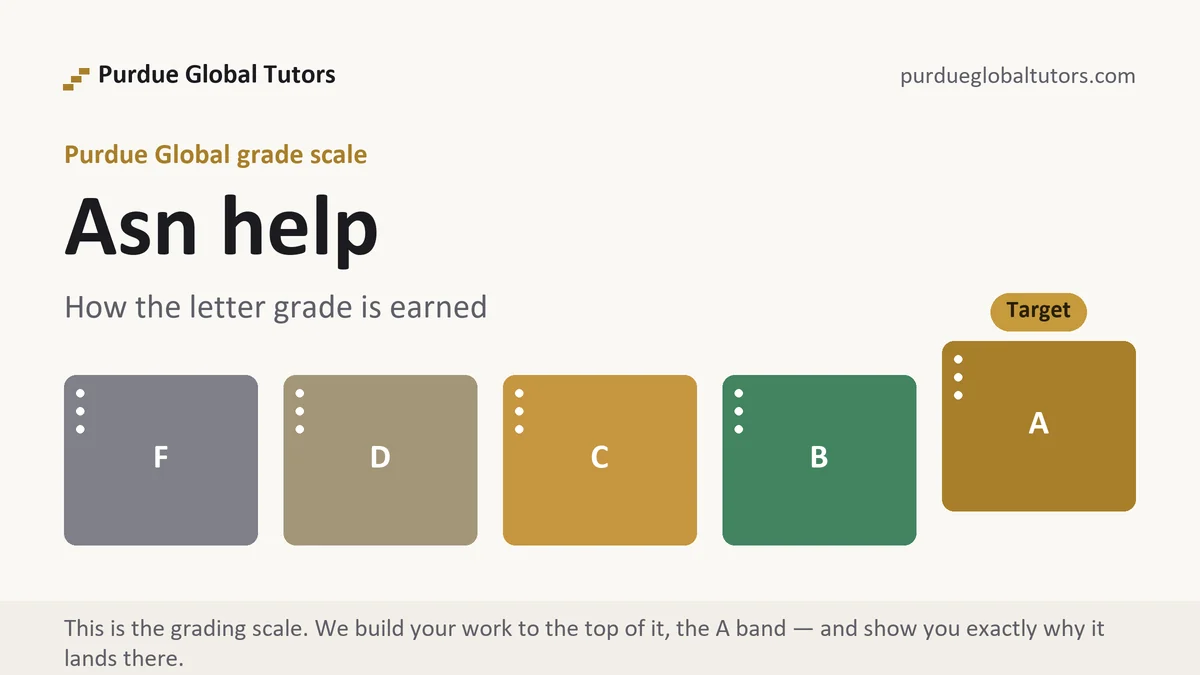
Traditional courses grade cumulatively, week by week, no final exam rescue, and the nursing scale compresses everything below 75 into an F, with the entire C band running 75 to 76.99. Work one example all the way through. Say your course grades ten equal weeks and you post a 68 and a 70 while the first clinical rotations eat your evenings. You have banked 138 points of a possible 200. To finish at exactly 75.0 you now need 612 points across eight weeks, an average of 76.5, which means clearing the whole C band every single week just to touch the lowest passing grade. To finish at a safer 80 you need 662 points, an 82.75 average, B-plus work for two months straight with no bad week allowed. The same two soft weeks in a standard undergraduate course would leave you needing a 74 average for a comfortable pass. That is the whole argument for treating weeks one through three as the cheapest insurance in the program. The money runs parallel: at the published nursing rate of $315 per quarter credit, five-credit NU 104 is a $1,575 course, so failing it costs $1,575 twice plus a resequenced grid, because the specialty row stacks on the foundations. A drafted, floor-checked week costs a fraction of that arithmetic and never has to be repeated.
The LPN/LVN pathway, priced in credits
Licensed practical and vocational nurses enter through NU 108 Health Professions Transitions, a six-credit bridge course, and the license itself converts into up to 22 quarter credits of the grid. Best case, 116 becomes 94 before tuition applies to it, the largest single discount available in this degree. The tradeoff is pace: the pathway respects what you already know, then drops you into the same med-surg ladder at the same ten-week cadence as everyone else, usually while you keep working the job that earned you the license. Pathway students are disproportionately the ones who bring us pharmacology and the med-surg sequence, not because the material is foreign but because the writing hours do not exist between shifts. Eligibility is location-limited like the rest of the program, so verify the credit award in writing before counting on the full 22.
The weekly handoff, start to finish
The mechanics are deliberately boring. You send three things in chat: the course code, the week, and the rubric from Brightspace, screenshots are fine. Add your clinical days for that week if the course has a CL twin, because the plan we build is only useful if it is built around the days you are in a facility until evening. A tutorship manager quotes scope and price in minutes, before any work starts, and the draft comes back to your personal email in 24 to 48 hours, checked against the nursing scale specifically rather than a generic percentage, with notes naming which rubric row each section answers. Then the part only you can do: read it, make it sound like you, and submit it from your own account. Anything that lands below target comes back for free revision. Seminars get prep notes rather than ghostwriting, because the live hour is yours to attend, and quiz weeks get a study kit built from the same course materials the draft used. Two requests make the whole machine work better: send the week before the week, not the night before the deadline, and send the gradebook whenever it changes, because every plan we run is arithmetic first and prose second.
In the ASN grid right now?
Course code, week, rubric from Brightspace. Floor-checked drafts on the nursing scale, first premium sample free.
Three ways ASN students use this, priced both directions
| Setup | What you hand over | When it fits | What it costs, both ways |
|---|---|---|---|
| One assignment or board | The single piece plus its rubric | You are steady and one clinical-heavy week collided with a paper | Smallest spend and fastest start, but nothing is watching the other nine weeks, and on a 75-floor scale the unwatched weeks are where terms die. The planning stays yours. |
| One theory course, all ten weeks | That syllabus in week one | Pharmacology or a med-surg course is the known threat and the rest of the term is manageable | Every graded item in the dangerous course lands planned and floor-checked, while the other courses stay fully yours, including their floors. Picking the wrong course to cover is the failure mode. |
| The whole term's theory load | Every syllabus plus your clinical schedule | A paired term where clinical days already own your evenings | Nothing slips and every deadline is planned around the days you are in a facility. It is also the largest commitment and the easiest to lean on; the rubric-mapped notes exist so the method transfers back to you. |
The honest reading of that last row cuts both ways. Students who cover a whole term finish it clean, and some finish it more dependent than they started. The margin notes tie each section of a draft to the rubric row it earns; read them for a term and the second term needs less of us. Ignore them and what you bought was scheduling, not skill.
The mistakes that actually cost grades here
Triaging nursing like general education. A 72 passes a standard undergraduate course and fails a nursing one. Students carrying core and major courses together apply one triage rule to both and lose the course that cannot afford it.
Treating weeks one and two as warm-up. The arithmetic above only runs one direction. Early points are the only cheap points in a cumulative course, and the recovery averages get ugly fast on a 75 floor.
Skipping the board on clinical weeks. A missed discussion is a fixed zero folded into the cumulative total, and clinical weeks are exactly when boards get skipped. Those are the weeks to hand off, not the weeks to forfeit.
Submitting a request with the prompt but no rubric. Prompts describe the topic; rubrics price it. A draft built without the pricing sheet is a guess wearing a thesis, however well it reads.
Arriving after the due date. Upstream of a deadline, everything is negotiable: drafts, revisions, pacing. Downstream of it sits a zero, and cumulative grading never forgets one.
Asking us for the CL side. The answer is a flat no every time, and the request burns runway that the theory work needed. Bring the written half early instead.