NU 263 (catalog code NU263), Medical-Surgical Nursing III, is the third pass through med-surg content, and the grading question changes with it. The first two courses asked whether you know what each condition is; this one asks what you do first when a patient has three of them at once. Written work here is scored on prioritization, on the pathophysiology chain that justifies the priority, and on knowing which pieces of the plan the RN keeps and which get delegated. A draft that describes every problem equally well but ranks nothing is the classic way to lose points in this course.
What NU 263 actually grades
Sequencing under pressure. The case studies stack complications deliberately, a post-operative patient who becomes septic, a heart failure admission with a potassium result that changes the morning's plan, and the rubric rows reward the student who names the first problem, defends the ranking with physiology, and only then writes the rest of the plan. Alongside prioritization sit two other graded skills: connecting assessment findings to the underlying disease mechanism instead of just listing them, and assigning work correctly across the care team, because delegation questions follow this course straight onto the licensure exam.
NU 263 runs beside NU 263CL, its on-ground clinical companion, which carries its own code, its own facility hours, and its own grade. What you bring us from NU 263 is the written and theory side: case studies, priority care plans, discussion boards, and quiz preparation.
How we help in this course
Send the case, the week's instructions, and the rubric from Brightspace. The draft you get back leads with the ranked problem list, ties each priority to the mechanism that earns its place, and keeps the delegation choices inside each state's RN scope as the prompt frames it. Where a scenario plants a deteriorating value on purpose, the draft treats it as the pivot of the whole plan rather than one finding among many, because that value is usually what the highest-weighted row is watching.
The process behind every order is the same one the rest of the site describes: the rubric read row by row before drafting, a nursing writer on the case, quality checks against the rubric and then a separate APA and originality pass, the undergraduate nursing scale applied before delivery, and the draft back inside 24 to 48 hours.
In NU 263 right now?
Send the case and the rubric from Brightspace. First premium sample free, scale-checked, back in 24 to 48 hours.
Late in the program, same 75 floor
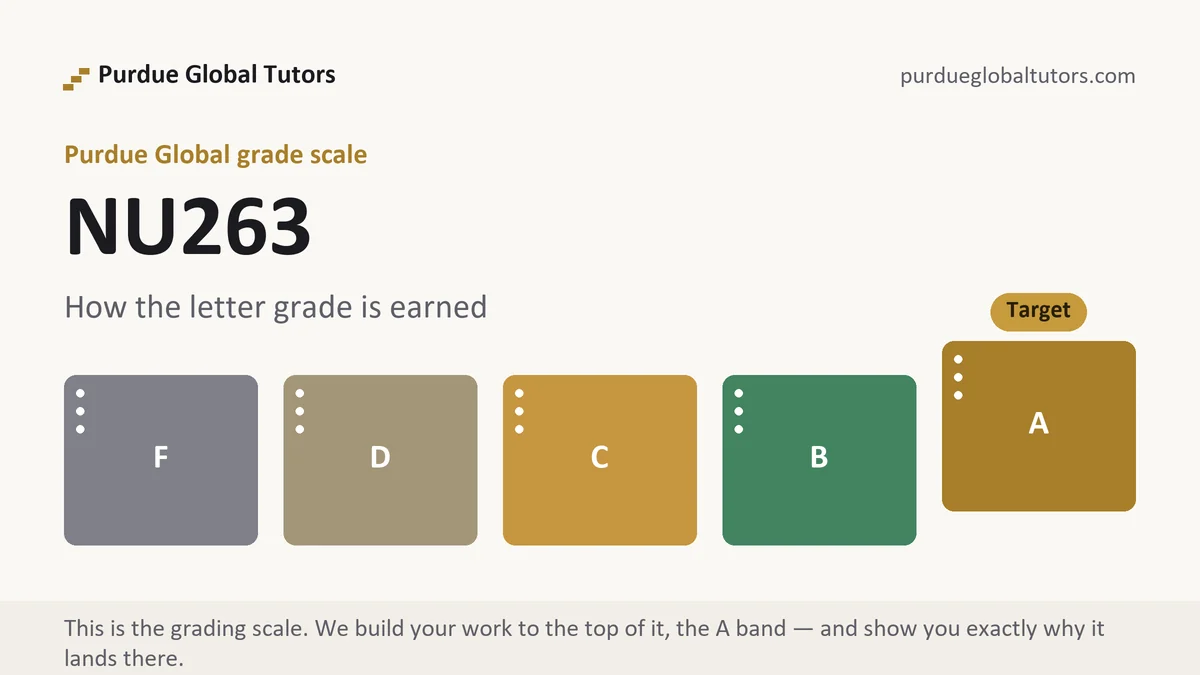
By the time NU 263 arrives you know the School of Nursing's undergraduate scale by heart: nothing below 75 passes, the C band is a sliver from 75 to 76.99, and the A waits at 93. What changes in a ten-week third-level course is the cost of a stumble. The material is the hardest in the ASN sequence, the weekly load still mixes written assignments, discussions, quizzes, and live seminars, and the students taking it are usually also carrying NU 263CL's facility hours in the same term. Time, not understanding, is the scarce resource, which is why the written weeks are the right place to buy margin. A banked 90 on a week-three case study is worth more than any amount of late-term cramming arithmetic.
Turn the rubric into a word budget
An illustrative NU 263 complex case study caps at 1,600 words and grades on four rows: focused assessment with prioritization at 25 percent, pathophysiologic reasoning at 25, interventions with delegation and collaboration at 30, and professional writing with APA at 20. Budget by multiplication: 400 words to sort the findings and defend the ranking, 400 to trace each priority problem back through its mechanism, and 480 for the intervention set, who does what, in what order, and why it is safe to assign. The writing row buys the remaining 320 words for the introduction, the transitions, and a conclusion that restates the ranking rather than summarizing the disease.
The budget warns you where instinct misleads. Students spend their length on interventions because interventions feel like nursing, but 400 words on reasoning is what separates this course from Med-Surg I, and a thin mechanism section drags two rows down at once, since the ranking loses its defense. If your section's rubric runs on points, convert first: divide the cap by the total points and spend words at that rate, then round toward the reasoning rows.
The parts of a complex-patient case study
Week to week the scenario changes; the graded skeleton mostly does not.
| Part | What it has to establish | The weak version graders see |
|---|---|---|
| Ranked problem list | Every active problem named, ordered by threat, the order defended in one sentence each | Problems listed in the order the scenario mentioned them |
| Focused assessment | The findings that matter for the top priorities, abnormals tied to trend and time | A full head-to-toe transcribed with nothing flagged |
| Mechanism trace | How each priority problem produces the findings observed, step by step | A textbook paragraph about the disease in general |
| Immediate interventions | First actions in sequence, each with a rationale and a monitoring parameter | A pile of reasonable actions with no order and no recheck |
| Delegation and collaboration | What stays with the RN, what goes to assistive personnel, what triggers the provider call | Everything done by an unnamed nurse; SBAR nowhere |
| Evaluation criteria | The numbers and findings that would say the plan is working, with a timeframe | The patient will stabilize, no measure attached |
Evidence craft for high-acuity writing
Third-level med-surg assignments ask for evidence behind the interventions, and the habits that protect the citation rows are concrete.
Put the design and the sample ahead of the claim. If a draft leans on a trial of early mobilization, the sentence starts with what kind of study it was and how many patients it followed, then reports the result. A randomized trial across 660 ICU admissions may carry a strong verb; an unattributed claim carries nothing.
Keep association verbs and causal verbs apart. Chart reviews and registry studies observe; they earn was associated with. Reduced, prevented, and improved are reserved for designs that assigned an intervention to one group and not another. Deterioration research is heavy with observational findings, and graders in this course read verbs closely.
No rate without its denominator and window. Write it as counted events, out of how many patients, over what period: readmissions per 1,000 heart failure discharges within 30 days is usable; a bare percentage is not. If the source gives the window, the draft keeps it.
Cite at clinical altitude. Protocols and early-warning criteria come from current professional guidelines and primary literature, dated, because acute-care practice standards move quickly and reference lists in this course get read.
Passing work, strong work, in NU 263
Passing work in this course is complete: all the problems appear, the interventions are safe, the citations exist. Its tell is flatness. Every problem gets equal ink, so the grader cannot find the ranking, and the delegation section names tasks without naming roles.
Strong work is visibly sequenced. The first paragraph commits to what kills the patient first, the mechanism section makes that choice look inevitable, the intervention list reads like the first hour actually unfolding, and the delegation calls are specific enough to defend, what the assistive personnel may take, what the RN cannot hand off, the exact finding that triggers the provider call. Strong work also builds in the recheck: every intervention carries the parameter that says whether it worked, which quietly answers the evaluation row before the grader gets there.
Six mistakes that cost points here
- Equal-weight problem lists. Ten problems described, none ranked. The highest row in most NU 263 rubrics is paying for the order.
- Mechanism by textbook. A general disease summary instead of a trace from this patient's findings to this patient's physiology.
- Delegating outside scope. Handing assessment or teaching to assistive personnel loses the delegation row outright.
- Interventions without rechecks. Every action needs the parameter and timeframe that proves it worked or did not.
- Ignoring the planted value. Scenarios seed one deteriorating number on purpose; a draft that treats it as background misses the point of the case.
- Citing the first two med-surg courses' textbook edition. Guideline-based rows want current, dated sources, not whatever the earlier course used.
Questions NU 263 students ask
Do you help with NU 263CL, the clinical course?
How do I defend a priority ranking when several problems look equally urgent?
The case has more problems than the word cap can cover. What gets cut?
Where NU 263 sits in Purdue Global's programs
Open the exact program map for public curriculum context. Concentrations, select-one rows, transfer and electives make the current degree audit authoritative.
The units, one by one
The public Degree Plan verifies NU 263, while Brightspace controls Unit 1 through Unit 10. A Unit manual is added only from a verified real deliverable; the ten-week calendar never invents an assignment.