NU 225 (catalog code NU225), Pediatric Nursing, grades whether you can take the nursing process you learned on adults and re-size it for patients who are still growing. Every written deliverable in this course turns on one move: anchoring the assessment, the outcomes, and the interventions to the child's developmental stage instead of to a shrunken adult. Miss that anchor and a technically correct care plan still reads generic, and generic is what the rubric rows are built to catch.
What NU 225 actually grades
Three abilities, stacked. Can you assess a child against age-specific norms, growth patterns, milestones, and vital sign ranges that shift with every developmental stage rather than against a single adult baseline. Can you plan care where the outcomes are measurable for that age, where a toddler's pain scale is not a number line and a school-age teaching plan does not read like an adult pamphlet. And can you keep the family in the frame, because pediatric nursing treats the caregiver as part of the patient unit, and rubrics in this course usually carry a family-centered row that students forget exists.
The course pairs with NU 225CL, the on-ground clinical companion, so the written side you bring us is theory, care plans, case studies, and boards. The clinical course is its own graded code with its own facility hours, and that side stays entirely yours.
How we help in this course
Send the week's instructions and the rubric from Brightspace, plus the case details if the assignment supplies a scenario. The draft comes back with the developmental stage named early and used throughout, dosing math shown step by step where the prompt asks for it, and family teaching written to the caregiver's reading level rather than the textbook's. Where a prompt leaves the age open, we pick one and commit, because a care plan written for children in general satisfies no rubric row fully.
Every order runs the standard machinery: rubric decoded row by row, a nursing writer on the draft, a rubric QA pass then a separate APA and originality pass, the 75-floor scale check, delivery inside 24 to 48 hours.
In NU 225 right now?
Send the week and the rubric from Brightspace. First premium sample free, scale-checked, back in 24 to 48 hours.
Ten weeks against the 75 floor
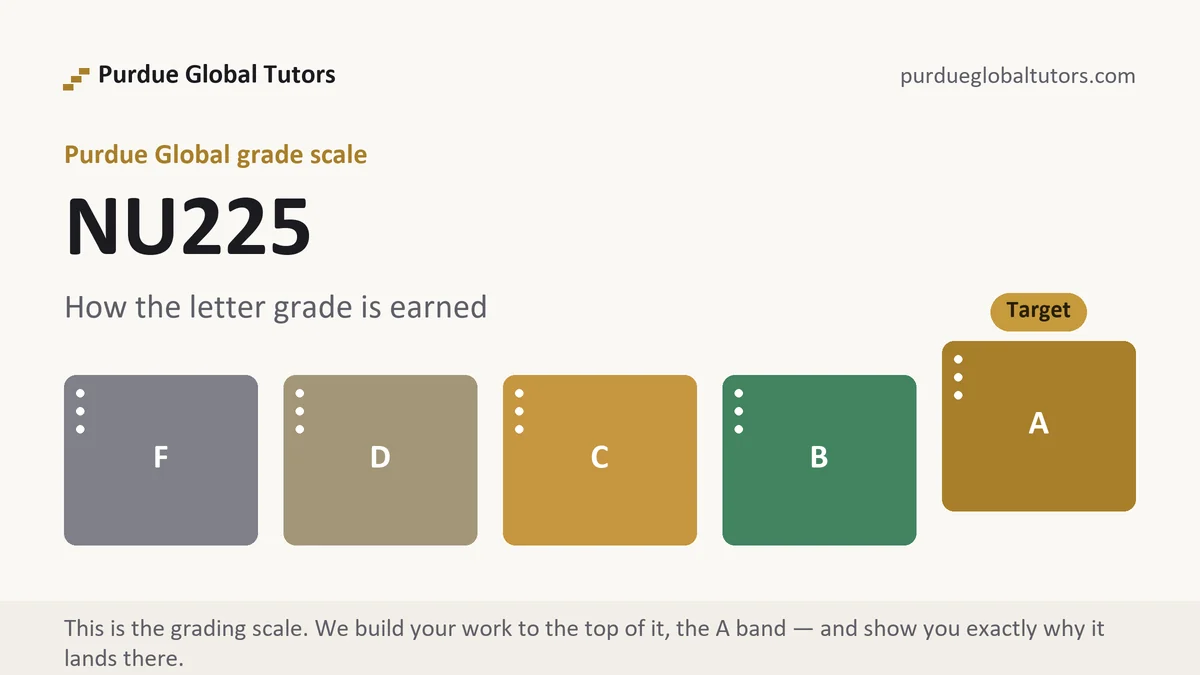
NU 225 sits on Purdue Global's undergraduate nursing scale, the one with no low passes: the C band runs 75 to 76.99 and anything below 75 is an F, while the A does not open until 93. The term is ten weeks on quarter credits, graded cumulatively from weekly work, discussions, written assignments, quizzes, and live seminars, with no high-stakes final waiting to rescue a slow start. A pediatrics week that scores in the low 70s is not a setback on this scale, it is a debt, and the recovery arithmetic gets uglier each week you carry it. The practical defense is to bank the early weeks while the content is still fundamentals review, because the back half of the course is where the condition-specific weeks concentrate.
Turn the rubric into a word budget
Take a typical NU 225 written case study capped at 1,400 words, with four rubric rows: developmental assessment at 30 percent, application of the nursing process at 35, safety and medication math at 20, and professional writing with APA at 15. Multiply the three content rows against the cap and the plan writes itself: 420 words for the developmental assessment, 490 for diagnoses through evaluation, and 280 for the safety section, which almost always means the dosing calculation shown with its formula and units. The writing row has no section of its own, so its 210 words fund the introduction and conclusion, and nothing else.
Two things fall out of that arithmetic. First, the assessment row is bigger than instinct says, because students want to rush to interventions; 420 words forces the milestone-by-milestone comparison the row is paying for. Second, 280 words on safety means the math cannot be a single line. Show the weight in kilograms, the ordered dose, the safe range from a cited reference, and the verdict. If your rubric runs on points instead of percentages, divide the cap by total points and spend words at that rate per point.
The parts of a pediatric care plan
Whatever the deliverable is called in a given week, the graded skeleton underneath is usually this one.
| Part | What it has to establish | The weak version graders see |
|---|---|---|
| Developmental snapshot | The child's age, stage, and expected milestones, with this child compared against them | An age in years with no norms attached |
| Assessment data | Findings sorted against age-specific vital and growth ranges, abnormals flagged | Adult reference ranges applied to a four-year-old |
| Nursing diagnoses | Prioritized problems in accepted format, tied to the data above | Diagnoses that could belong to any patient on the unit |
| Outcomes | Measurable, time-bound, and possible for this stage, stated per diagnosis | The child will improve, with no measure or clock |
| Interventions with rationale | Actions sized to the child, each with a because-clause a source backs | Interventions listed bare, rationale column empty or circular |
| Family teaching | What the caregiver must know, phrased for the caregiver, checked for understanding | A paragraph aimed at clinicians, not parents |
| Evaluation | Whether each outcome was met, partially met, or not, and what changes if not | A closing sentence that the plan worked |
Evidence craft for pediatric writing
Pediatric assignments lean on statistics more than students expect, immunization coverage, injury rates, prevalence of a condition by age band, and the sourcing habits that protect the grade are specific.
Name the design and the sample before the finding. A cohort study of 2,100 infants followed through age two is allowed to say what it found; a finding floated with no study behind it is an assertion. One clause is enough, but it comes first.
Match the verb to the design. Observational work on, say, screen time and sleep gets was associated with. Caused, reduced, and prevented belong only to designs where something was deliberately given to one group and withheld from another. Pediatric literature is full of associations dressed as causes, and instructors in this course mark the costume every time.
Give every rate its denominator and its window. Fourteen falls per 1,000 hospitalized children per year is a usable number. A lot of falls is not, and neither is a bare percentage with no base and no stretch of time. Write what was counted, out of how many, over what period, then the figure.
Source at the right altitude. Milestones, dosing ranges, and schedules come from current authoritative references, not from parenting sites, and the reference year matters because pediatric guidance moves.
Passing work, strong work, in NU 225
A passing NU 225 care plan is accurate: the diagnoses are legal, the interventions are safe, nothing is wrong. What it lacks is the child. Swap the age in the header and the plan still stands, which means the developmental rows earned partial credit at best.
Strong work is visibly age-locked. The outcomes could only belong to this stage, the teaching section addresses the actual caregiver, the dosing math shows its units, and at least one intervention acknowledges what this developmental stage makes hard, a preschooler's magical thinking about illness, an adolescent's privacy demands. Strong work also treats the family row as content rather than garnish, because that is the row most often left thin, and thin rows are where averages slide toward the 75 line.
Six mistakes that cost points here
- The shrunken adult. Adult interventions with smaller numbers. The row wants stage-specific reasoning, not scaled-down copies.
- Dosing without the work shown. A correct milligram answer with no weight, formula, or safe-range comparison scores as a guess.
- Outcomes with no clock or measure. Will tolerate feeds is not measurable. Give an amount and a timeframe the stage allows.
- The invisible family. If the caregiver appears nowhere in assessment, teaching, or evaluation, an entire rubric row went unanswered.
- One pain scale for all ages. Naming the wrong tool for the age undercuts the whole assessment section for a grader.
- Citing parenting websites. Growth norms and safety guidance need authoritative, dated sources, and reference lists get checked.
Questions NU 225 students ask
Do you help with NU 225CL, the clinical course?
The prompt does not say which age to write for. How do I choose?
How much weight does the medication math actually carry?
Where NU 225 sits in Purdue Global's programs
Open the exact program map for public curriculum context. Concentrations, select-one rows, transfer and electives make the current degree audit authoritative.
The units, one by one
The public Degree Plan verifies NU 225, while Brightspace controls Unit 1 through Unit 10. A Unit manual is added only from a verified real deliverable; the ten-week calendar never invents an assignment.