Bachelor of Science in Business Administration class guide
A current, source-bounded path for Bachelor of Science in Business Administration: choose the exact official class code, then move into Unit 1 through Unit 10 without inventing work from the calendar.
Course IDs from the official catalog Degree Plan tables are linked wherever this site has a class guide. General education, open elective, concentration, transfer, and select-one rows remain choices; the page never presents every listed option as one student's fixed schedule. The directory identity, academic-catalog link, class destinations and right-side navigation are complete.
Read the public degree plan correctly
Purdue Global currently lists this as a bachelor's program in Business. The official marketing page describes the current offering and points to the academic catalog Degree Plan used here. The current marketing page lists these concentrations: Aviation Management, Business Development, Construction Management, Digital and Social Media Management, Financial Analysis, FinTech, Global Marketing Management, Hospitality Sustainability, Human Resources, Information System Management, Management, Procurement, Project Management, Real Estate, Sport Entertainment Management, Supply Chain Management and Logistics, Wealth Management and Financial Planning.
The table lists the Course IDs printed in the public plan, including fixed requirements and codes shown inside catalog options. It does not turn every concentration, elective or select-one row into one student's requirements. The current degree audit, transfer evaluation and advisor-approved schedule remain authoritative.
The program and catalog sources were last checked against the 2026-2027 catalog on October 3, 2026. Check both linked sources before registration because program availability, concentrations, state restrictions, course choices and catalog requirements can change. This tutoring map is a navigation and learning layer, not an enrollment promise.
Gain the knowledge, technical skills, and decision-making abilities to prepare for a wide range of career paths. Gain more control over how you learn with ExcelTrack®, our competency-based option.
The classes, one by one
| Course code | Catalog title | Quarter credits | Public basis |
|---|---|---|---|
| AC 114 | Accounting I | 5 | official catalog Degree Plan row |
| AC 116 | Accounting II | 5 | official catalog Degree Plan row |
| AV 102 | Aviation History | 5 | official catalog Degree Plan row |
| AV 203 | Aviation Operations Management | 5 | official catalog Degree Plan row |
| AV 412 | Aviation Finance | 5 | official catalog Degree Plan row |
| AV 438 | Airline Operations | 5 | official catalog Degree Plan row |
| AV 475 | Aviation Law | 5 | official catalog Degree Plan row |
| BU 204 | Macroeconomics | 5 | official catalog Degree Plan row |
| BU 224 | Microeconomics | 5 | official catalog Degree Plan row |
| CM 107 | College Composition I | 5 | official catalog Degree Plan row |
| CM 220 | College Composition II | 5 | official catalog Degree Plan row |
| CS 212 | Communicating Professionalism | 5 | official catalog Degree Plan row |
| FI 310 | FinTech Principles and Concepts | 6 | official catalog Degree Plan row |
| FI 311 | FinTech Law and Ethics | 6 | official catalog Degree Plan row |
| FI 410 | Blockchain for the Financial Industry | 6 | official catalog Degree Plan row |
| HR 400 | Talent Acquisition and Management | 6 | official catalog Degree Plan row |
| HR 410 | Talent Development and Learning | 6 | official catalog Degree Plan row |
| HR 420 | Workplace Law, Labor Relations, and HR Risk Management | 6 | official catalog Degree Plan row |
| HR 435 | Total Rewards and Compensation Strategy | 6 | official catalog Degree Plan row |
| HR 485 | Strategic HRM: Analytics and Business Decision-Making | 6 | official catalog Degree Plan row |
| IT 301 | Project Management I | 6 | official catalog Degree Plan row |
| IT 401 | Project Management II | 6 | official catalog Degree Plan row |
| IT 402 | IT Consulting Skills | 6 | official catalog Degree Plan row |
| LS 311 | Business Law | 6 | official catalog Degree Plan row |
| LS 312 | Ethics and the Legal Environment | 6 | official catalog Degree Plan row |
| MM 255 | Business Math and Statistical Measures | 5 | official catalog Degree Plan row |
| MM 305 | Business Statistics and Quantitative Analysis | 6 | official catalog Degree Plan row |
| MT 140 | Introduction to Management | 5 | official catalog Degree Plan row |
| MT 203 | Human Resource Management | 5 | official catalog Degree Plan row |
| MT 209 | Small Business Management | 5 | official catalog Degree Plan row |
| MT 217 | Finance | 5 | official catalog Degree Plan row |
| MT 219 | Marketing | 5 | official catalog Degree Plan row |
| MT 220 | Global Business | 5 | official catalog Degree Plan row |
| MT 240 | Sport in Society | 5 | official catalog Degree Plan row |
| MT 241 | Sport Analytics | 5 | official catalog Degree Plan row |
| MT 242 | Managing Sport Programs | 5 | official catalog Degree Plan row |
| MT 243 | Sport Sponsorships and Sales | 5 | official catalog Degree Plan row |
| MT 281 | Fundamentals of Construction Management | 5 | official catalog Degree Plan row |
| MT 282 | Construction Methods and Materials | 5 | official catalog Degree Plan row |
| MT 300 | Management of Information Systems | 6 | official catalog Degree Plan row |
| MT 302 | Organizational Behavior | 6 | official catalog Degree Plan row |
| MT 313 | Corporate Sustainability and Social Responsibility | 6 | official catalog Degree Plan row |
| MT 314 | Social Innovation and Entrepreneurship | 6 | official catalog Degree Plan row |
| MT 330 | International Marketing and Business Development | 6 | official catalog Degree Plan row |
| MT 340 | Conflict Management and Team Dynamics | 6 | official catalog Degree Plan row |
| MT 355 | Marketing Research and Analytics | 6 | official catalog Degree Plan row |
| MT 357 | Digital Marketing Platforms and Strategy | 6 | official catalog Degree Plan row |
| MT 358 | Social Media Marketing and AI Optimization | 6 | official catalog Degree Plan row |
| MT 359 | Integrated Marketing Communications | 6 | official catalog Degree Plan row |
| MT 361 | Foundations of Real Estate Practice | 6 | official catalog Degree Plan row |
| MT 381 | Construction Planning and Scheduling | 6 | official catalog Degree Plan row |
| MT 382 | Construction Cost Estimating | 6 | official catalog Degree Plan row |
| MT 383 | Construction Law | 6 | official catalog Degree Plan row |
| MT 400 | Business Process Management | 6 | official catalog Degree Plan row |
| MT 421 | Financial Planning | 6 | official catalog Degree Plan row |
| MT 422 | Portfolio Management | 6 | official catalog Degree Plan row |
| MT 423 | Asset Allocation and Risk Management | 6 | official catalog Degree Plan row |
| MT 431 | Real Estate Finance and Ethics | 6 | official catalog Degree Plan row |
| MT 432 | Real Estate Law | 6 | official catalog Degree Plan row |
| MT 433 | Global Supply Chain Management | 6 | official catalog Degree Plan row |
| MT 434 | Logistics and Distribution Management | 6 | official catalog Degree Plan row |
| MT 435 | Operations Management | 6 | official catalog Degree Plan row |
| MT 436 | Purchasing and Supply Chain Management | 6 | official catalog Degree Plan row |
| MT 437 | Strategic Warehouse Management | 6 | official catalog Degree Plan row |
| MT 438 | Analytics in the Digital Supply Chain | 6 | official catalog Degree Plan row |
| MT 445 | Managerial Economics | 6 | official catalog Degree Plan row |
| MT 450 | Brand Management Strategy | 6 | official catalog Degree Plan row |
| MT 451 | Managing Technological Innovation | 6 | official catalog Degree Plan row |
| MT 453 | Professional Selling | 6 | official catalog Degree Plan row |
| MT 455 | Strategic Management of Sales | 6 | official catalog Degree Plan row |
| MT 459 | Consumer Behavior | 6 | official catalog Degree Plan row |
| MT 460 | Management Strategy and Policy | 6 | official catalog Degree Plan row |
| MT 475 | Quality Management | 6 | official catalog Degree Plan row |
| MT 480 | Corporate Finance | 6 | official catalog Degree Plan row |
| MT 481 | Financial Markets | 6 | official catalog Degree Plan row |
| MT 482 | Financial Statement Analysis | 6 | official catalog Degree Plan row |
| MT 483 | Investments | 6 | official catalog Degree Plan row |
| MT 499 | Bachelor's Capstone in Management | 6 | official catalog Degree Plan row |
| TH 116 | Introduction to Hospitality, Event Management, and Tourism | 5 | official catalog Degree Plan row |
| TH 206 | Hotel Management and Operations | 5 | official catalog Degree Plan row |
| TH 213 | Food and Beverage Management | 5 | official catalog Degree Plan row |
| TH 311 | Sustainable Hospitality Management | 6 | official catalog Degree Plan row |
Turn the catalog map into a registered-term board
Begin with the active degree audit, not the longest possible catalog list. For each registered class, record the code, format, term dates, Unit or module-course status, discussion obligations, seminar time, grading scale, point weights, rubric, project dependencies, clinical or workplace dependencies and next action.
Traditional courses use cumulative grading across the term. Keep each discussion, reply, assignment, seminar or approved alternative, quiz, project stage and final upload as a distinct obligation. ExcelTrack students instead track each module course, readiness result, competency gaps, summative attempt rules and completion state.
Record the time zone beside every deadline and use the current classroom statement when rules differ. A generic calendar cannot establish the exact seminar policy, the number of replies, a late-work rule or a summative retake process for a particular section.
Convert the real rubric into the work plan
Copy every scored criterion or competency into a requirement ledger before researching. Give each row an action verb, evidence need, destination, completion test and status. If a top band asks for analysis, synthesis or application, define the intellectual move that makes it visible instead of simply increasing length.
Keep instructions and scoring rows side by side. Directions control scenario, audience, file type, length and constraints; the rubric controls what earns points. In a competency assessment, the performance statement and evidence conditions become the acceptance test. In a traditional assignment, each weighted row needs a visible answer.
For projects staged across units, maintain one decision ledger: scenario facts, definitions, data periods, assumptions, sources, stakeholders, calculations, recommendations and instructor feedback. Build the final from corrected decisions rather than joining old submissions with contradictions intact.
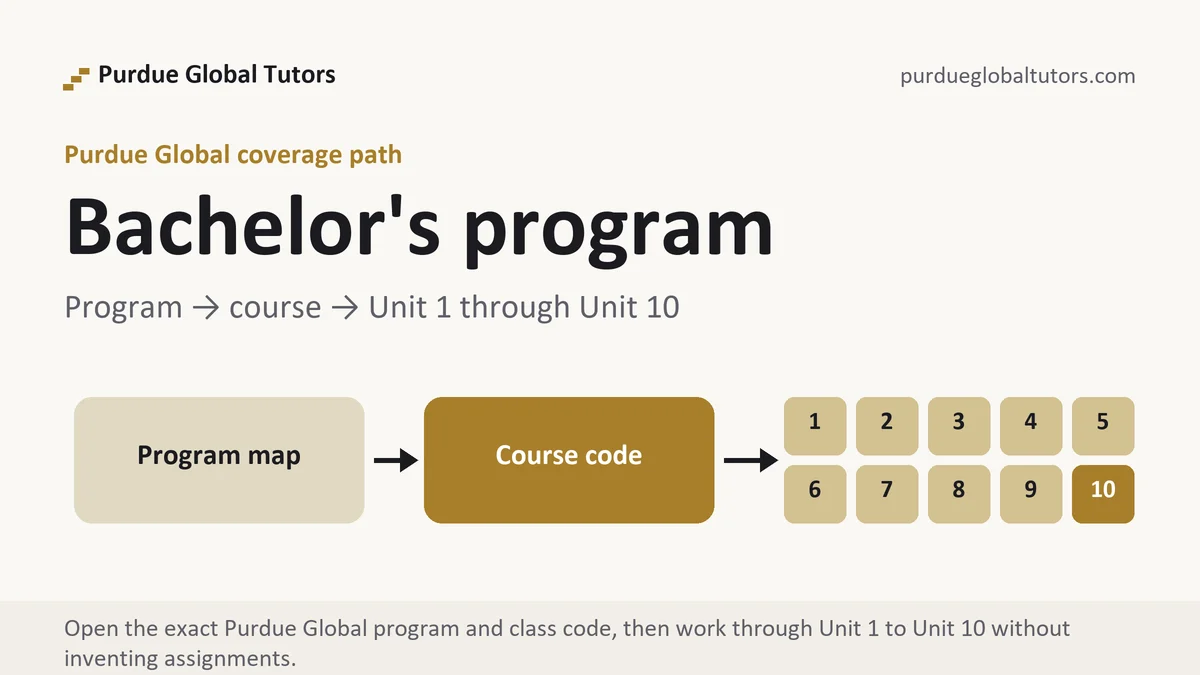
Program → course → Unit 1 through Unit 10
This is the standard Purdue Global path. A traditional course normally runs on a fixed 10-week schedule with readings, learning activities, graded assignments, discussion boards and scheduled live seminars. The class guide turns that cadence into a controlled Unit 1 through Unit 10 board.
Ten units prove timing, not ten identical assignments. A unit can contain several obligations, and course revisions can move or replace a deliverable. A public Unit manual appears only after the real Brightspace directions, rubric or other authoritative assignment identity is verified.
Use the correct Purdue Global grading population
Purdue Global publishes different scales for standard undergraduate, School of Nursing undergraduate, graduate, and module or doctoral courses. Record the scale printed in the current syllabus before forecasting a grade. A percentage can mean different academic standing under different populations.
ExcelTrack summative competency assessments use the module-course standard, where B-level performance begins at 80%. Traditional courses accumulate weekly scores, so a missed discussion or seminar obligation can change the required average across every remaining item. Never promise a letter outcome without the registered scale and current points.
After grading, classify feedback as coverage, reasoning, evidence, calculation, format, communication or professional-boundary work. Correct the smallest complete unit, trace dependent claims and exhibits, and write one prevention rule for the next Unit or module course.
Quality and professional boundaries
Run a content pass before a delivery pass. Confirm that every scoring row has an answer, claims fit their evidence, calculations expose inputs and units, limitations are visible, recommendations follow from the analysis, and all tables, figures and prose agree. Then check citations, references, template, filename, file type, accessibility and upload rendering.
Students remain responsible for real discussions, decisions, data authorization, clinical or workplace activity, practicum hours, signatures, identity-verified assessments and final submission. Tutoring can explain, plan, review, calculate, rehearse and help revise de-identified work; it cannot impersonate a student or manufacture experience.
Keep the working draft, exported artifact and upload receipt as separate records. When feedback arrives, version the correction and trace it through every dependent section. That small control prevents a revised table or clinical assumption from disagreeing with the narrative that relies on it.
Use the hierarchy for different questions. The program map answers which public degree plan names the code. The class guide answers how to control the scoring instrument and course rhythm. A Unit or summative manual, when verified, answers how one real deliverable is structured. Keeping those jobs separate prevents a broad catalog description from being mistaken for current classroom directions.
When a live artifact becomes available, verify its header, code, Unit or module-course identity, version, scenario, submission format and scoring instrument before wiring it below the class. Preserve historical distinctions when a later section changes the deliverable instead of silently presenting two versions as one assignment.