NU 650 (catalog code NU650), AGACNP Introduction to Acute Care Management I, is where the adult-gerontology acute care sequence stops teaching sciences and starts grading decisions. The written work centers on the admitted adult: take a case at the door of the hospital, assemble what is known into a prioritized problem list, and write the initial management, the workup, the treatment, the monitoring, and the reasoning that connects them. The grade lives in prioritization and in the visible link between data and orders, and the common failure is a write-up that manages every problem with equal energy, which in acute care is the same as prioritizing nothing. This page maps the rubric, the parts of an admission-style write-up, the evidence habits, and the term's recurring mistakes.
What NU 650 actually grades
Fifth in the twelve-course sequence and first after the specialized pharmacology course, NU 650 grades four movements that every later course in the acute care line will assume. Synthesis: turning a case's scattered data, history, examination findings, early results, into a coherent clinical picture, stated briefly and without repeating the case verbatim. Prioritization: a problem list in order of threat, where the order itself is an argument and the grader checks whether you can tell what is dangerous from what is merely present. Initial management: the first set of decisions for each problem that matters, diagnostics that discriminate, treatment that begins, monitoring that would catch deterioration, each traceable to a finding above it. And anticipation: what could go wrong in the next day, and what in your plan is already watching for it. The fourth movement is what separates this course from a medical-surgical write-up; acute care rubrics reward the plan that expects trouble.
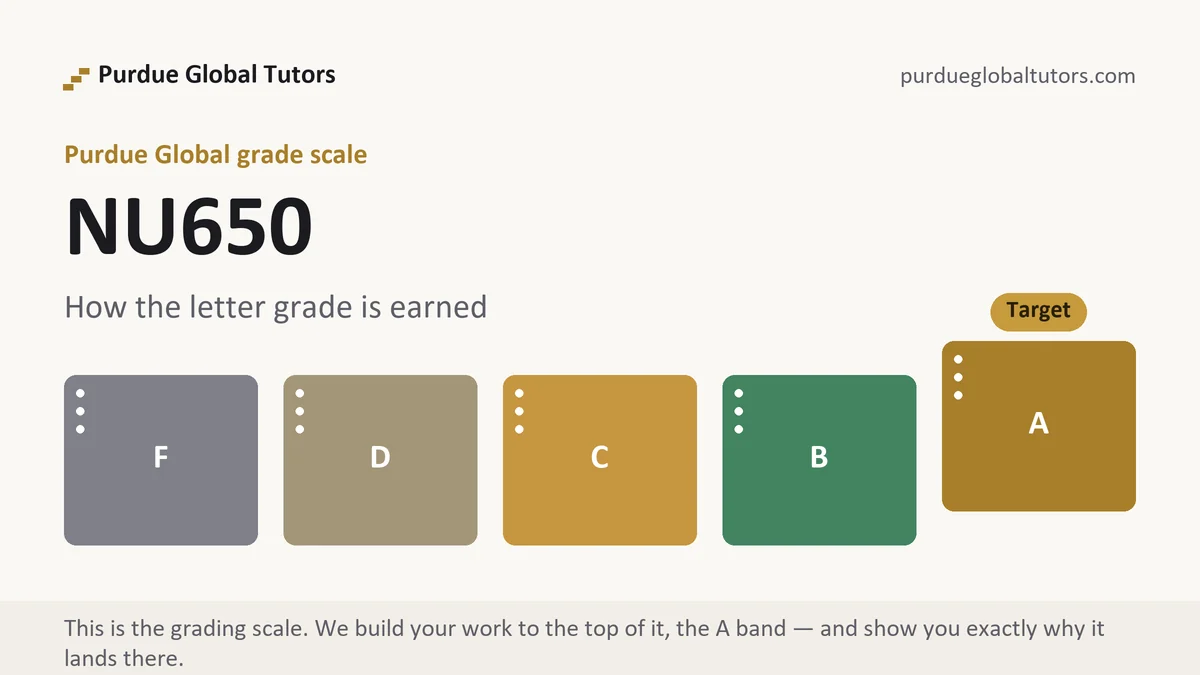
The container is standard for the school: ten weeks on quarter credits, five credits of weekly deliverables, discussion boards at graduate register, live seminars in Brightspace with a written alternative when the time cannot work. The case complexity climbs steadily, and by the term's back half the write-ups involve more systems than any single week has taught, which is deliberate; the course is building toward its paired clinical, and our grading guide's graduate scale, passing at 70 with the C band from 70 to 79.99, leaves little room for a slow start.
How we help in this course
Send the week, the case as your section assigned it, the prompt, and the rubric from Brightspace. The write-up comes back inside 24 to 48 hours with the problem list ranked and defended, the workup chosen to discriminate rather than to blanket, management tied line by line to the data, and a walkthrough of the reasoning so the shape transfers to the next case.
Two lines stay fixed. This is academic work for your submission and your faculty's grading, not clinical advice, and no plan written here is for use on a real patient. And the clinical course paired with this one is entirely yours: hours, preceptors, sites, logs, and signatures belong to you, and we touch none of them; what we build is the written layer around your didactic work. Inside those lines, every order runs the full machinery: rubric decoded row by row, a writer matched to acute care management work, a rubric QA pass, a separate APA and originality pass, and a final check against the graduate bands your section grades on.
In NU 650 right now?
Send the admission case and the rubric out of Brightspace. First premium sample free, problem list ranked, in 24 to 48 hours.
The sequence around it, and the legacy set
NU 650 is the current catalog code, five quarter credits, taken by the AGACNP track once the MSN core and NU 551, NU 552 and NU 553 are complete, alongside its clinical, NU 651, and followed by the diagnosis and management courses (NU 648, the AGACNP pharmacology course, is due before NU 652) that carry the sequence to critical care. For continuing students on the older curriculum the catalog carries a legacy line whose nearest relative is MN 651, AGACNP Introduction to Acute Care Management, a four-credit course; the legacy set packages the acute care material across slightly different course sizes and Roman numerals than the current one, so if your registration shows MN codes, match by title rather than by number and read your own syllabus as the authority. The craft on this page, ranked problem lists, discriminating workups, plans traced to data, holds across both sets; what shifts is rubric wording and where each system's content lands in the term. Whichever code you carry, confirm it before sending work, because the two curricula weight their rows differently even when the assignment looks the same.
Turn the rubric into a word budget before you write
Admission-style write-ups fail by geometry more than by knowledge: the case summary swells, the first problem gets a thorough plan, and the third problem gets a sentence. The fix is arithmetic done before drafting.
Worked example on an illustrative rubric (your section's own cap and rows set the real numbers): a management write-up capped at 900 words with five percentage rows: data synthesis at 20 percent, problem identification and prioritization at 20, management plan at 30, rationale and evidence at 20, writing and APA at 10. The content rows buy 180, 180, 270, and 180 words, with 90 left to fund the frame and the close. Two consequences follow immediately. Your synthesis is 180 words, which forbids retelling the case; it must compress. And your management section, the largest, still has to divide across every problem your list ranks, so a three-problem case gives each problem roughly 90 words of plan, which is why the discriminating test beats the comprehensive panel; you cannot afford to order everything and justify it. Sections graded in points convert the same way: divide the cap by the total, and a 90-point rubric on 900 words prices the 25-point management row at 250 words before you have written any of them.
The parts of an acute care management write-up
Names vary by section; the graded anatomy does not. Each part below has a weak version that recurs in every term's stack.
| Part | What it has to establish | The version that loses points |
|---|---|---|
| Clinical synthesis | The picture in a short paragraph: who arrived, what is unstable, what the early data shows | The case restated in full, in order, as it was given |
| Problem list, ranked | Problems in order of threat, with the ranking logic visible | An alphabetical or as-mentioned list with no order argument |
| Differential where it matters | For the unstable problem, the candidates and the findings that separate them | A differential attached to every problem, including the obvious ones |
| Diagnostic plan | Tests chosen to discriminate or to stage, each tied to the question it answers | A panel ordered by habit with no question attached |
| Therapeutic plan | Treatment per ranked problem, doses adjusted to the case, sequenced by urgency | Guideline text pasted in without the patient's numbers |
| Monitoring and escalation | What is watched, how often, and the threshold that changes the plan | Continue to monitor, unattached to any value |
| Anticipated course | The likely next 24 to 48 hours and the complications the plan is already watching for | No forward look at all; the plan ends at the orders |
Citing evidence in a management paper
Management write-ups cite to justify decisions, and the citation belongs where the decision is. A reference list that is technically adequate but floats free of the plan earns less than a thinner list wired into it, because the rationale row is asking a specific question: for each consequential choice, what supports it. The habits that hold up: put the source at the decision point, so the sentence that picks the diagnostic or the therapy carries its support in the same breath. Name what kind of source it is, since a clinical practice guideline, a trial of a stated size, and a review article authorize different strengths of claim, and the verb should match. Prefer the guideline for what is recommended and the primary study for what happened, and never run the lanes backward. Anchor every number to its population and window, because acute care statistics move sharply with the cohort. And when the case forces a choice the guideline does not cover, an old patient, a conflicting condition, a drug the list will not tolerate, say so explicitly and reason through it; rubrics in this course reward the visible handling of tension far more than the pretense that none exists.
Passing write-up, strong write-up
A passing NU 650 write-up finds the right problems, orders reasonable things, and cites competently. A strong one shows its ranking. You can read the problem list and know why the second problem is second, because the threat logic is stated. Its diagnostic section is small and sharp, tests that decide something, each with its question named, instead of the broad panel that spends words and earns nothing. Its therapy shows the case's own numbers inside the doses. Its monitoring paragraph could be executed by someone else, values, intervals, thresholds, actions. And it looks forward: a short paragraph on what the next two days probably hold and how the plan would catch the turn. Graders describe the difference simply: the passing paper proves the student studied, the strong paper reads like it was written by someone who expects to be responsible for the patient tomorrow morning.
Six mistakes that cost points here
- Retelling instead of synthesizing. The opening spends 400 words repeating the case the grader already has, and the synthesis row pays nothing for it.
- Flat problem lists. Every problem treated as equally urgent reads as an inability to rank, which is the exact skill the course grades.
- Shotgun diagnostics. Ordering the full panel without questions attached; the rubric pays for discrimination, not coverage.
- Plans that ignore the case's numbers. Renal function sitting in the data while every dose arrives at the textbook default.
- Monitoring as a verb. The word monitor without a value, an interval, or a threshold scores as filler in every rubric this course uses.
- No forward paragraph. Ending at the initial orders and leaving the anticipation row, often a fifth of the management weight, unearned.
Questions NU 650 students ask
The cases feel bigger than what the weeks have taught. Is that normal?
How is this graded differently from the med-surg write-ups I did before?
Can you help me get ready for the clinical that follows this course?
Where NU 650 sits in Purdue Global's programs
Open the exact program map for public curriculum context. Concentrations, select-one rows, transfer and electives make the current degree audit authoritative.
The units, one by one
The public Degree Plan verifies NU 650, while Brightspace controls Unit 1 through Unit 10. A Unit manual is added only from a verified real deliverable; the ten-week calendar never invents an assignment.