NU 420 (catalog code NU420) is the six quarter credit leadership and management course in Purdue Global's baccalaureate nursing catalog, and its written work is graded on one move: taking a management problem you can actually see on a unit, naming the leadership theory that explains it, and proposing something a charge nurse could start on Monday. Opinion about good leaders earns nothing. A recommendation with a mechanism, a cost, an owner, and a way to tell whether it worked earns the top rows. It runs ten weeks in Brightspace with weekly deliverables and live seminars, on the School of Nursing undergraduate scale where anything below 75 is an F. We draft, revise, and build seminar notes for the written half inside 24 to 48 hours.
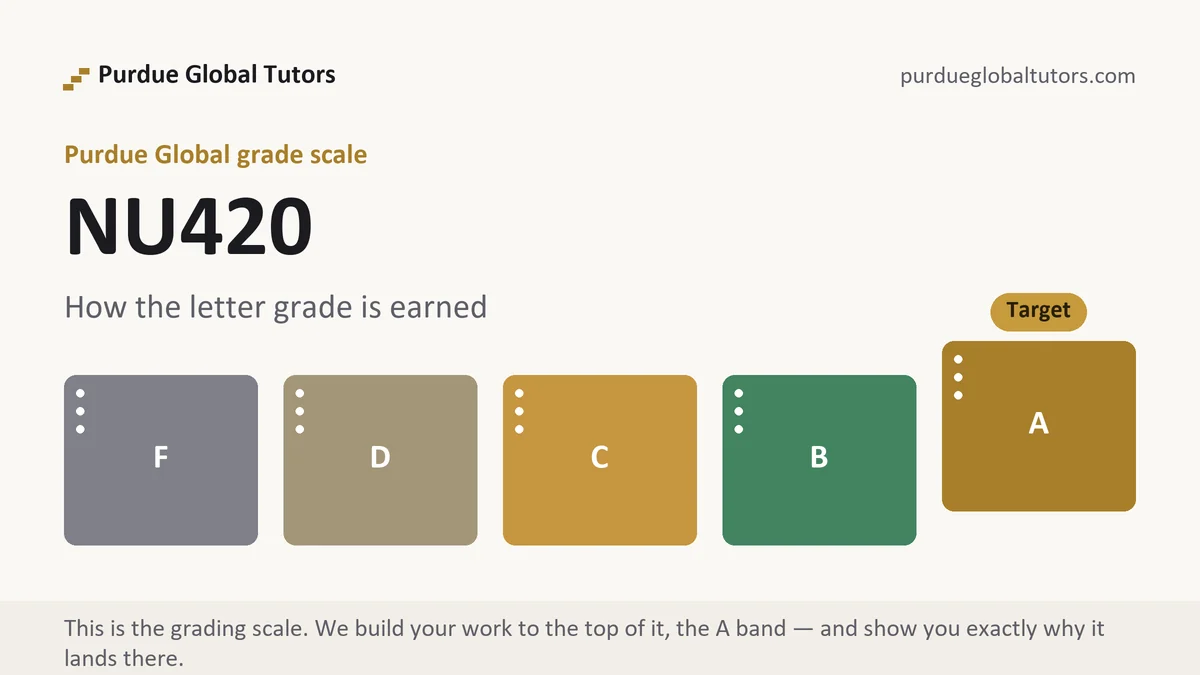
What NU 420 actually grades
Three things, and the order matters. First, whether you can describe an organizational problem at the right altitude. Students either write too small, one difficult colleague, or too large, the whole American health system, and both miss the unit of analysis this course wants, which is a team, a shift, a department, a process. Second, whether the leadership or management theory you name is doing real work. Naming transformational leadership and then never using it again is a citation, not an analysis. Using it to explain why a staffing change failed when the manager announced it by email is analysis. Third, whether your recommendation is executable. The scoring guides in management courses reward specificity that reads almost boring: who does what, starting when, paid for how, measured by which number.
NU 420 also carries a code note worth knowing before you start. It sits in the catalog as a baccalaureate leadership course, while the current RN-to-BSN plan of study routes most students through NU 425 instead. If your advisor placed you in NU 420, you are almost certainly on an earlier grid or a catalog year that still lists it, and the coursework is graded the same way. Send us the plan of study screenshot with your first order and we will read your sequence from it rather than guessing.
Turning rubric rows into a section plan, with the arithmetic
Management papers bloat because the subject invites storytelling. The defense is a budget written before the first paragraph. Open the scoring guide in Brightspace, list the rows, assign each row a share of the points, and convert that share into words.
Here is a worked case. Suppose the unit asks for a 1,500 word leadership analysis with five scored rows: problem description worth 15 percent, theory application worth 30 percent, proposed intervention worth 30 percent, evaluation plan worth 15 percent, and writing with APA worth 10 percent. The arithmetic gives 225 words to the problem, 450 to theory, 450 to the intervention, 225 to evaluation, and 150 of prose that visibly demonstrates scholarly writing, which usually lives in your synthesis paragraphs rather than in a section of its own. Introduction and conclusion sit outside those numbers, so hold them to roughly 120 words each and treat them as overhead.
Two consequences fall out immediately. Your problem description, the part most students write longest because it is the part they know best, is the smallest paid section in the paper. And theory plus intervention together own 60 percent of the grade, which means more than half your writing time belongs to two sections most drafts finish in twenty minutes. If your guide uses raw points rather than percentages, divide total words by total points to get a words-per-point rate and apply it row by row. Send a screenshot of the guide in chat if a row is written vaguely; scope answers come back the same day and cost nothing.
The parts of a leadership issue analysis
Whatever the unit calls the deliverable, the dominant written form in NU 420 is an analysis of one management problem with a proposed response. These parts recur, and each has a weak version graders meet every term.
| Part | What it has to establish | The weak version |
|---|---|---|
| The setting, briefly | Unit type, staffing mix, patient population, and the constraint that makes this problem hard here | Three paragraphs of hospital history before the problem appears |
| The problem, in observable terms | What happens, how often, to whom, and what it costs in time, money, or safety | Morale is low, stated as a fact with no observable behind it |
| Theory doing work | A named leadership or management framework used to explain why the problem persists | A definition paragraph about a theorist, then a return to opinion |
| The proposed intervention | Concrete actions, an owner for each, a start point, and the resources they consume | Improve communication, listed as a step |
| Stakeholders and resistance | Who loses something under your plan and how the plan survives that | A list of stakeholders with no losses assigned to anyone |
| Evaluation | The metric, the baseline, the collection method, and the review point | Success will be evaluated through feedback |
The resistance row is where NU 420 papers separate. Every real management change takes something from someone: an hour, a preference, an informal power arrangement. A draft that names the loss and says how the plan absorbs it reads like leadership. A draft that assumes everyone will cooperate reads like a wish, and graders in this course have read a great many wishes.
In NU 420 right now?
Send the unit, the prompt, and the scoring guide from Brightspace. Floor-checked draft back in 24 to 48 hours, first premium sample free.
Evidence and citation craft in a management paper
Leadership literature comes in three grades and mixing them is the most common quiet error in this course. Theory sources, including textbooks and the original framework papers, establish what a model claims. Professional and regulatory sources establish what an organization is expected to do. Research studies establish what happened in a particular set of units under particular conditions. A recommendation built only on theory sources is a philosophy paper. A recommendation built only on a single study is a generalization waiting to be marked.
When you use a study, put the design and the sample in front of the finding. A stepped implementation across four medical surgical units in one system is a different warrant from a survey of nurses recruited through a professional association, and your reader should know which one is speaking before the result arrives. The habit costs you one clause and buys you the evidence row: in a study of forty two staff nurses on two night shift units, the intervention was followed by fewer missed care events.
Verbs carry the rest of the weight. Survey and correlational work supports association language: linked to, more common among, reported alongside, associated with. Only a design with a comparison condition supports reduced, increased, or prevented. Management writing tempts you toward causal verbs because the whole genre is about making things happen, which is exactly why the slip goes unnoticed until the grader circles it. Say that transformational leadership scores were associated with lower reported intent to leave. Say that the pilot reduced overtime only if something was actually compared.
Rates need a denominator and a window before the number appears, every time. Turnover of a certain percentage is meaningless until you say among whom and over what period. Twenty one percent of registered nurses on one unit left within twelve months is checkable. If your source gives you a number without a denominator or a period, it came from a summary rather than from research, and your intervention section is stronger without it.
Passing versus strong in NU 420
A passing paper is organized and generic. It has all the required headings, a defensible problem, a correctly cited theory, and a recommendation that no one could argue with because nothing in it is specific enough to argue with. On the nursing undergraduate scale that tends to land in the high seventies, which passes and sits closer to the 75 floor than most students expect from a paper that felt finished.
A strong paper is auditable. Someone could take the intervention section, walk onto the unit, and start it. The theory section explains a behavior that would otherwise look irrational, such as why experienced staff quietly route around a new protocol. The evaluation section names a number that exists in a real system, not a number you would have to invent a survey to collect. And the paper admits at least one limitation of its own plan, because a leader who cannot name what might fail has not thought about implementation yet.
Six mistakes that cost points here
Diagnosing a person instead of a system. The manager is difficult is not a problem statement. Turn it into a process, a workload, or an information failure and the paper suddenly has somewhere to go.
Theory as decoration. One paragraph defining a model, then no further mention of it, loses the largest row in most NU 420 guides even when the definition is correct.
Verbs without owners. Communication will be improved and training will be provided are sentences with nobody in them. Every action in the intervention section needs a role attached.
An evaluation plan with no baseline. If you cannot say what the number is now, you cannot say the number improved, and the evaluation row is graded on exactly that.
Trade press cited as research. Practice magazines and vendor white papers are useful for context and are not evidence for effect. Use them to show a problem is recognized, not to show a solution works.
Coasting through the first units. Traditional courses build the grade cumulatively across all ten weeks, and against a 75 floor two soft early submissions convert the rest of the term into recovery arithmetic. Bank the early points and the term stays uneventful.
Questions NU 420 students ask
Can I write about my own workplace, and how much detail is safe?
How is NU 420 different from NU 425?
Does NU 420 support include anything clinical?
How the week actually runs with us
Send the course code, the unit number, and the scoring guide in chat, screenshots are fine. A tutorship manager quotes scope before any work starts, and the draft returns to your personal email inside 24 to 48 hours with margin notes naming which row each section answers, checked against the nursing undergraduate scale rather than a generic percentage. Then your part: read it, make the setting sound like your setting, and submit from your own account. Anything that lands under target comes back for free revision. Seminar weeks get talking points rather than a script, because the live hour is yours to attend, and board weeks get posts that take a position instead of agreeing with the person above you. Two habits make this work better: send the unit when it opens rather than the night it closes, and send the gradebook whenever it changes, because the plan we build for your remaining weeks is arithmetic first.