NU 333 (catalog code NU333), Health Assessment for the Nursing Professional, grades documentation, not bedside skill. You already assess patients; this course scores how you write it down. We return scale-checked drafts of every write-up inside 24 to 48 hours, built against the 75-point nursing floor.
What NU 333 actually grades
NU 333 sits on the RN-to-BSN grid at five quarter credits across a ten-week term, and it carries a quiet irony: every student in the room performs assessments for a living, yet the course grades something most working nurses rarely practice, the long-form academic write-up of an assessment. A shift assessment lives in checkboxes and shorthand. NU 333 asks for the opposite register: complete sentences, ordered sections, a documented health history, subjective and objective data kept strictly apart, and sources cited in APA when a screening recommendation or a risk statistic enters the page.
That gap between doing and documenting is where the points move. The nurse who can auscultate accurately but writes "lungs clear, no issues" loses to the classmate who records what was examined, what was found, and what was specifically absent. Purdue Global does not publish syllabi, so the weekly deliverable list lives in your Brightspace shell, but the catalog description and the course's position in the BSN-level sequence make the shape predictable: system-focused write-ups building toward comprehensive documentation, weekly deliverables plus live seminars, ten units without a pause.
How we help in this course
Our NU 333 work centers on model documentation. Send the unit's instructions and rubric from Brightspace and a nursing-matched writer returns a draft that shows the academic register your charting habits actively fight: history sections in full prose, findings organized by system, pertinent negatives stated rather than implied, and every guideline claim carrying a citation.
Each order runs the full sequence: the rubric decoded into a section plan, the draft written to it, a rubric QA pass, then a separate APA and originality check, then the floor check against the undergraduate nursing scale before delivery inside 24 to 48 hours. When a seminar week and a write-up collide with your shift schedule, tell us which deadline bites first and we sequence around it.
In NU 333 right now?
Send the unit and the rubric from Brightspace. First premium sample free, checked against the nursing scale, back in 24 to 48 hours.
Rubric rows into a section plan, with the arithmetic
Assessment rubrics reward coverage, so the fastest planning move is to convert the rubric's percentage column into a word budget before writing a line. Suppose your comprehensive write-up rubric reads: subjective data 25 percent, objective data 25 percent, synthesis and problem identification 20 percent, health promotion 15 percent, organization and APA 15 percent, with a 1,500-word target. The budget falls out directly: about 375 words for the history and review of systems, 375 for examination findings, 300 for the synthesis, 225 for health promotion, and the last 225 absorbed by introduction, conclusion, and formatting overhead.
The common failure is inversion: 700 words of history because interviews generate material easily, then 150 words of synthesis because the deadline arrived. Synthesis rows are where graders separate grades, precisely because they cannot be filled by transcription. Budget words where the points sit, and when a row says "identifies at least three risk factors," count them in your draft the way the grader will, with a finger on the screen.
The anatomy of a health assessment write-up
Whatever the unit's focus system, the dominant deliverable in a course like this keeps one skeleton. The table below is the version we build drafts around; your rubric's wording controls wherever it differs.
| Section | What it must do | Typical share |
|---|---|---|
| Identifying data and reason for assessment | Demographics, setting, and why this person is being assessed, two or three sentences, no diagnosis yet | 5 percent |
| Health history | Present concern, past medical and surgical history, medications, allergies, family and social history, in prose | 20 percent |
| Review of systems | Subjective reports system by system, including explicit denials, worded as what the person told you | 15 percent |
| Objective findings | What you inspected, palpated, percussed, auscultated, and measured, by system, with pertinent negatives | 25 percent |
| Synthesis and problem list | Cluster subjective and objective data into prioritized concerns, each traceable to findings above | 20 percent |
| Health promotion | Screening and lifestyle recommendations tied to this person's age, history, and risks, cited to current guidelines | 10 percent |
| References | APA entries for every guideline, tool, or statistic named | 5 percent |
Two boundary rules do most of the grading work. Anything the person told you is subjective and belongs in history or review of systems, however clinical it sounds. Anything you observed or measured is objective. A sentence like "patient reports occasional dizziness, blood pressure 132 over 84" straddles the line and loses points in both rows; split it.
Evidence and citation craft in an assessment course
NU 333 write-ups cite fewer sources than a research course, which makes each citation more visible. Three habits protect those points. First, when you bring in a study to justify a screening choice, name the design and sample before the finding: "a cohort of 4,000 community-dwelling adults" tells the reader what the number can carry before the number lands. Second, match your verb to the evidence. Observational findings earn association language, "is associated with," "correlates with"; only designs built for causation earn "reduces" or "prevents." Writing that a screening tool "prevents falls" when the cited study only observed fewer falls among screened patients is the kind of overclaim that assessment faculty are specifically trained to catch.
Third, no rate without its denominator and window. "High readmission rates" is decoration; "readmissions per 100 discharges within 30 days" is evidence. The same discipline applies to prevalence claims in your health promotion section: say the population and the time frame or leave the number out. And date your guidelines. Screening recommendations revise on a cycle, and citing a superseded version in a promotion plan reads as carelessness even when the advice barely changed.
Passing versus strong in NU 333
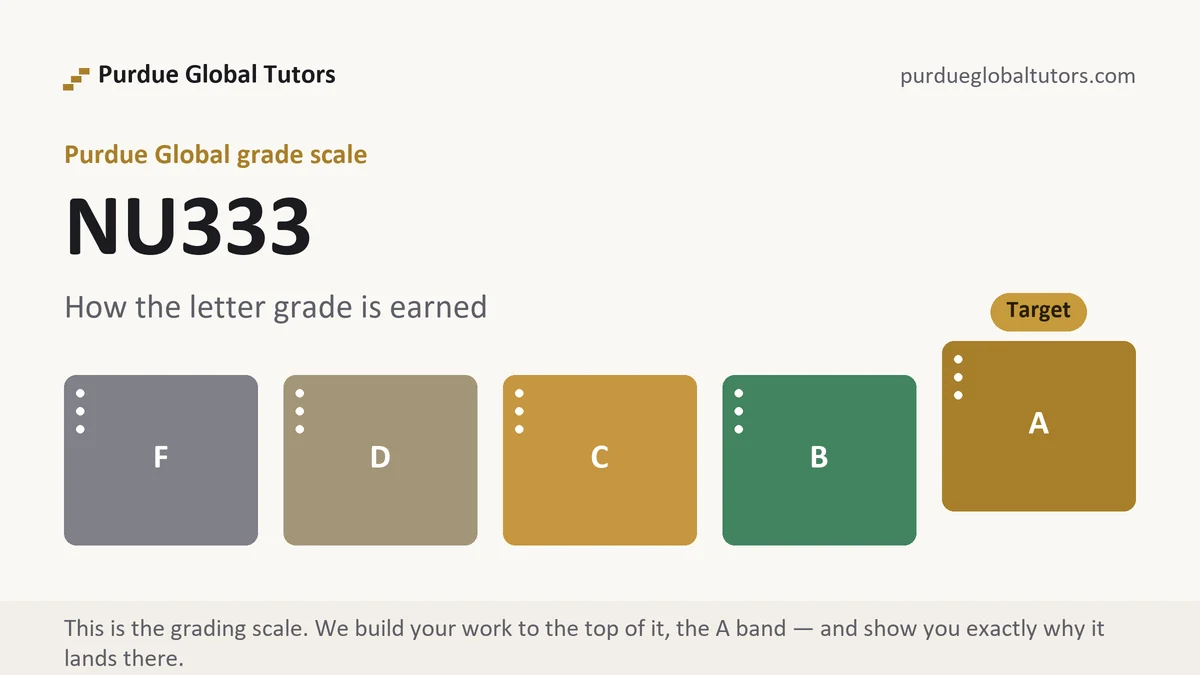
NU 333 grades on the undergraduate nursing scale, the harshest undergraduate ladder Purdue Global runs: the entire C band spans 75 to 76.99, anything below 75 fails, and the A opens at 93. Since Traditional courses build the final grade cumulatively from weekly scores, a weak first write-up leaves you doing recovery math against a 75 floor for nine remaining units, in a course where a strategic 70 that would pass a gen-ed simply fails.
A passing write-up completes every section and keeps subjective and objective data separated. A strong one does three more things. It documents pertinent negatives, the findings you looked for and did not find, because their absence is what makes the positive findings mean anything. It clusters, connecting the reported symptom in the history to the examination finding four paragraphs later instead of leaving the reader to join them. And its health promotion section is written for the person actually assessed, the 52-year-old with the smoking history and the family cardiac picture, not for adults in general. Generic promotion plans are the most reliable marker of a rushed submission, and graders treat them accordingly.
Six mistakes that cost points here
Charting voice in an academic paper. Abbreviations, sentence fragments, "WNL" and its cousins. The habit that makes you fast at work reads as incomplete here; write it out.
Subjective data leaking into objective sections. "Patient states" belongs in history and review of systems. One misplaced report can cost in two rubric rows at once.
An empty review of systems. "Denies all other symptoms" without naming the systems asked scores as a skipped section. List what was covered and what was denied.
Uncited screening advice. Every recommendation in the promotion section needs a current, dated guideline behind it. Faculty check the year.
Findings without negatives. Recording only what was abnormal makes the exam look partial. Pertinent negatives prove the assessment was systematic.
Coasting through the early units. Cumulative grading against a 75 floor means units one through three set the term's ceiling. Bank them while the material is lightest.
The unit, the seminar, and the handoff
NU 333 runs on Purdue Global's Traditional rhythm: ten units in a ten-week term, each carrying readings, a graded deliverable, and a live seminar, with discussion boards threading through. For a working RN the pinch point is rarely difficulty; it is the collision between a twelve-hour shift block and a unit that closes at midnight. The handoff that protects the grade is simple and repeatable. When the unit opens in Brightspace, send the instructions and the rubric the same day, not the day the deliverable is due. The draft comes back inside 24 to 48 hours with a walkthrough explaining why each section is built the way it is, so the version you submit is one you could defend in seminar. Board posts ride same-day when a deadline is close.
Seminars themselves are live and yours to attend; most shells post an alternative assignment for a missed session, and when that alternative is a written piece it moves through the same pipeline as any other deliverable. NU 333 appears in the catalog as a single five-credit course, and the catalog does not list ExcelTrack module variants for it, so there is no M-suffix pairing to plan around; the weekly cadence above is the whole game.
What to send for an accurate scope
Four things: the course code, the unit number, the rubric, and a line about the person you plan to assess, their age band and general health picture, because a documentation draft grounded in a real assessment subject reads truer than one built on a composite. If your gradebook already has entries, include the screenshot. The floor math on the nursing scale comes back with the scope, so you know the exact average the remaining units must hold, and the plan for the back half of the term is arithmetic instead of worry.
Questions NU 333 students ask
Does NU 333 require assessing a real person?
Purdue Global does not publish syllabi, so your Brightspace shell is the authority. Courses of this shape commonly ask you to document an assessment of a consenting adult volunteer and write it up academically. Whatever your section requires, we work from your posted instructions and rubric, and the documentation side, the structure, register, and citations, is exactly what we draft.
What grading scale applies to NU 333?
The undergraduate nursing scale. The C band runs 75 to 76.99, anything below 75 is an F, and the A range opens at 93. It is stricter than the standard undergraduate scale, where a D at 60 still passes, so NU 333 cannot be triaged the way a gen-ed course can.
I assess patients every shift. Why would I need help with this course?
Because the course grades writing, not technique. The register that makes you efficient at the bedside, shorthand, abbreviations, exception-based charting, is the same register that loses points in academic documentation. Our drafts show the long-form version of skills you already have, which is why NU 333 clients tend to need us less as the term goes on.
Questions about NU 333
Does NU 333 require assessing a real person?
What grading scale applies to NU 333?
I assess patients every shift. Why would I need help with this course?
Where NU 333 sits in Purdue Global's programs
Open the exact program map for public curriculum context. Concentrations, select-one rows, transfer and electives make the current degree audit authoritative.
The units, one by one
The public Degree Plan verifies NU 333, while Brightspace controls Unit 1 through Unit 10. A Unit manual is added only from a verified real deliverable; the ten-week calendar never invents an assignment.