MN 667 (catalog code MN667), PMHNP Diagnosis and Management Across the Lifespan III, is a prior curriculum code: the closing course of the legacy lifespan trio, still running for continuing students, while current cohorts take the same subject as NU 677 in the NU 670-series. If your degree audit prints MN 667, you are in the right place; if it prints NU 677, start there, since rubric paperwork travels with the code. The third lifespan course is where the vignettes stop being clean: comorbid presentations, layered medications, competing priorities, and cases where two reasonable clinicians could sequence treatment differently. The graded skill is synthesis, holding a complicated patient in one coherent document, prioritizing what gets treated first, and defending the sequence. This page maps what that rewards, a worked budget for a complex-case paper, its anatomy, the craft of citing evidence that conflicts, and the questions MN 667 students still send us at the end of the didactic road.
What MN 667 actually grades
Synthesis breaks down into four testable skills. Prioritization: a comorbid case offers several defensible starting points, and the paper is graded on whether you name a first target and give the reason, severity, risk, treatability, or the dependency of one condition on another, rather than treating everything at once on paper. Interaction reasoning: layered medications and overlapping syndromes create interference, pharmacologic and diagnostic, and graders look for the paragraph that checks it explicitly. Sequencing: a plan for a complex patient is an order of operations, what starts now, what waits, what would reorder the queue, and writing it as sequence is what separates synthesis from a stack of single-disorder plans. And coordination: complex cases touch other clinicians, primary care, therapy, sometimes higher levels of care, and the plan is graded on naming who else is involved and what is referred out. Risk architecture runs under all four, because comorbidity moves risk, and the developmental fitting the trio is named for still applies at every age the vignettes span.
The container holds steady: a ten-week quarter-system term, five quarter credits, weekly Brightspace deliverables, graduate-register discussion boards, live seminars with a written fallback, unit-organized material across the ten weeks. As the last didactic stretch of the legacy sequence, MN 667 sections sit close to graduation, and the writing is graded at the register the credential implies.
How we help in this course
Send the full case, the prompt, and the rubric from Brightspace, and flag the code as MN 667 so the writer matches your section's documents rather than the NU prefix's. Complex vignettes reward complete transmission: every diagnosis mentioned, every medication with dose, and whatever history the case supplies, because the interaction and sequencing sections are built from exactly those details. Papers return inside 24 to 48 hours with a named first target and its defense, the interaction check written explicitly, the plan sequenced rather than stacked, coordination and referral named, and the risk architecture adjusted for the comorbidity, plus the annotated walkthrough students headed toward certification tend to keep.
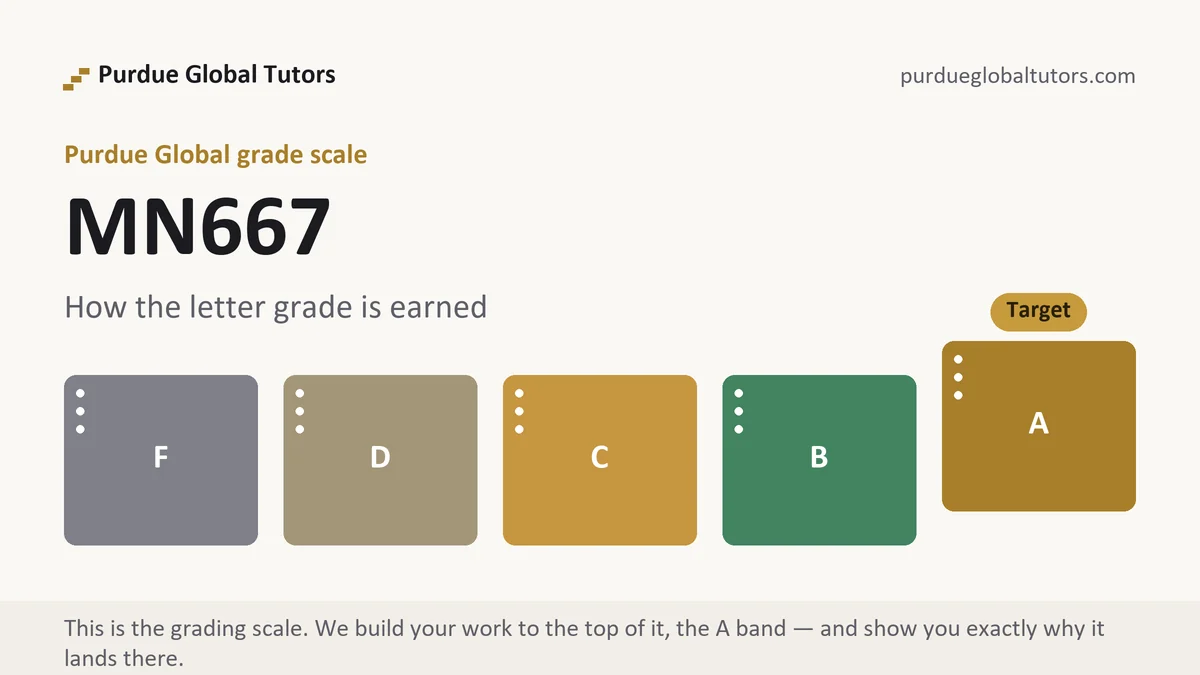
The boundary stands where it always stands: the legacy clinical courses, printed at 130 hours each in the catalog, are entirely yours, hours, preceptor and site contact, logs, and every verified document, and we do not touch any of it under any circumstance. Inside the written lane, each order runs the full pipeline: rubric decoded row by row, a psychiatric-track writer, a rubric QA pass, a separate APA and originality pass, and a final read against the graduate scale in our grading guide, 70 to pass, C band 70 to 79.99.
In MN 667 right now?
Send the case with every medication and diagnosis it lists, plus the rubric. First premium sample free, sequenced and defended, in 24 to 48 hours.
The last legacy didactic, and the numbers around it
The catalog runs two PMHNP curricula in parallel: the current NU 670 through NU 678 and the legacy MN 660 through MN 669, kept published for continuing students. MN 667's current twin is NU 677, identical title, the third lifespan diagnosis course in either prefix. The numbering at this end of the legacy sequence is actively misleading: the catalog lists MN 668 as Clinical III and MN 669 as Clinical II, each printed at 130 clinical hours, so the final clinical courses sit in reversed numeral order and the course after this didactic is a degree-audit question, not an arithmetic one. The other standing facts transfer: no ExcelTrack module versions exist anywhere in the specialty sequence, so MN 667 runs only as the ten-week traditional term, and the catalog does not publish which populations or disorders each lifespan numeral covers, so your section's schedule owns the topic scope while the synthesis method here holds across arrangements. If you are comparing notes with NU 677 students, remember the craft transfers and the paperwork does not: rubrics are section property, and we always work from yours.
Budget the complex case before it budgets you
Complex-case papers fail by sprawl: every diagnosis gets a full workup, every medication gets a paragraph, and the word cap arrives before the plan does. The correction is the same arithmetic as every rubric conversion, applied more ruthlessly because the material tempts you harder.
Worked example on an illustrative rubric (your section's own cap and rows set the real numbers): a complex-case management paper capped at 2,200 words with five percentage rows: case synthesis and prioritization at 25 percent, interaction and comorbidity analysis at 20, sequenced treatment plan at 25, risk and safety architecture at 15, scholarly support and mechanics at 15. The content rows buy 550, 440, 550, and 330 words. Synthesis and plan are twin peaks, and the lesson sits between them: the synthesis section exists to produce the priority order the plan then executes, so if your synthesis does not end with a named first target, the plan starts unfunded. The 440 interaction words are specific work, the drug pairs checked, the diagnostic overlaps considered, the finding that changes a choice, not a pasted interaction table. The 330 risk words must respond to the comorbidity rather than restating a single-disorder template. A 55 point rubric against the same cap prices 40 words per point, so an 11 point interaction row is another 440 word obligation. Put the numbers into the outline first, and sprawl loses its main ally, which is drafting order.
The parts of a complex-case management paper
Section titles differ across course shells, but the graded anatomy of a comorbid-case paper is stable, and each part has a version that loses points every term.
| Part | What it has to establish | The version that loses points |
|---|---|---|
| Case synthesis | The whole patient in one organized account, conditions weighted, not listed | Serial mini-workups stapled together |
| Priority determination | The first treatment target and the named reason it goes first | Everything treated at once, nothing ranked |
| Interaction analysis | The drug pairs and diagnostic overlaps checked, with the finding that matters | A generic interaction warning attached to no specific pair |
| Sequenced plan | What starts now, what waits, and the condition that would reorder the queue | A stack of single-disorder plans with no order of operations |
| Risk and safety architecture | Stratification that reflects how the comorbidity moves risk, with a matching structure | A single-disorder risk template pasted onto a layered case |
| Coordination and referral | Who else is involved, what is referred, and what stays with the PMHNP | A plan written as if no other clinician exists |
| Monitoring across conditions | The measures tracked per condition and the interval each runs on | One follow-up sentence covering three diagnoses |
Citing evidence that disagrees with itself
Comorbid cases break the comfortable citation pattern of one guideline per paper, and MN 667 graders watch how you handle the break. Four habits earn the rows. When two guidelines collide, and treating either condition alone would worsen the other is the classic vignette design, name both recommendations, name the conflict, and resolve it with a stated principle, risk first, severity first, or the dependency of one condition on another, rather than citing only the guideline that agrees with your plan. Mind the evidence gap that comorbidity opens: trial populations are cleaner than layered cases by design, so say in one clause that the patient sits outside the validation population and size your confidence accordingly, which reads as literacy, not weakness. Keep effect sizes honest when stacking treatments, because benefits documented separately do not simply add. And cite interaction claims to something checkable, a named reference or database and the specific pair, since vague interaction hand-waving is the section graders discount first. The standing craft runs underneath, design before result, denominators on every number, but conflict handling is the evidence skill this course specifically prices.
Passing paper, strong paper
A passing MN 667 paper accounts for every condition, avoids dangerous combinations, and produces a defensible plan for each diagnosis. A strong paper is one decision architecture. Its synthesis ends in a ranking, and the ranking's reason is in the case. Its interaction section reports findings that change choices, not warnings in general. Its plan reads as a sequence with a trigger list, what starts now, what waits, and precisely what result would promote the waiting item. Its risk section shows the comorbidity moved the stratification, and the safety structure moved with it. Its coordination section knows what a PMHNP holds and what gets referred. And its citations survive disagreement: both guidelines named, the conflict resolved on a principle, confidence sized to a trial population the patient does not quite match. The passing paper proves you can manage each disorder; the strong one proves you can manage the patient who has all of them, and the top rubric bands here are written for exactly that proof.
Six mistakes that cost points here
- The stapled workups. Serial single-disorder sections with no synthesis; the genre grades the joints, not the parts.
- No first target. Treating everything simultaneously on paper, which reads as refusing the question the case asks.
- The generic interaction warning. Caution advised with no specific pair checked; graders discount it to zero.
- The unsequenced plan. Interventions listed without an order of operations or a trigger that would reorder them.
- The template risk section. Single-disorder stratification pasted onto a layered case the rubric priced for comorbid risk.
- Cherry-picked guidelines. Citing only the recommendation that agrees with the plan while the conflicting one goes unmentioned.